
2012 Dodge Grand Caravan 3.6 Firing Order
Hey there, fellow Dodge Grand Caravan owner! Are you wrestling with engine misfires, rough idling, or a general lack of power in your 2012 Grand Caravan with the 3.6L Pentastar engine? If so, you might be looking for information about the firing order. Getting the firing order and cylinder layout correct is absolutely crucial for proper engine operation. A mistake here can lead to significant problems and even engine damage, so let’s get this right.
Understanding the 2012 Dodge Grand Caravan 3.6L Firing Order
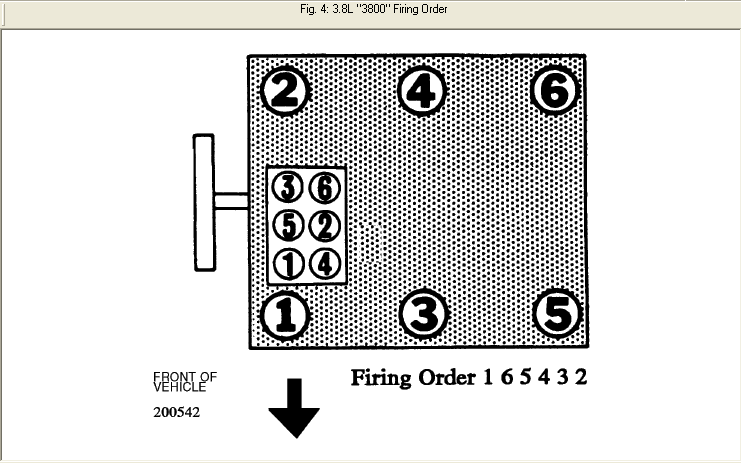
The 2012 Dodge Grand Caravan, equipped with the 3.6L Pentastar V6 engine, has a specific firing order and cylinder numbering. This information is vital when diagnosing misfires, replacing spark plugs, or performing other engine maintenance. Here's the key information you need:
- Firing Order: 1-2-3-4-5-6
This means that the cylinders ignite in that sequence. Understanding how the cylinders are arranged is equally important.
Cylinder Numbering and Layout
The 3.6L Pentastar engine has two cylinder banks. Looking at the engine from the front of the vehicle (where the belts and pulleys are), the cylinder banks are arranged as follows:
Bank 1: The bank closest to the firewall (rear of the engine compartment).
Bank 2: The bank closest to the radiator (front of the engine compartment).
Within each bank, the cylinders are numbered sequentially:
Bank 1: Cylinders 1, 3, and 5 (from front to back of the engine compartment on that bank).
Bank 2: Cylinders 2, 4, and 6 (from front to back of the engine compartment on that bank).
Therefore, if you're standing in front of your Grand Caravan, looking into the engine bay, Bank 2 (cylinders 2, 4, and 6) is on your left, and Bank 1 (cylinders 1, 3, and 5) is on your right.
Why is the Firing Order Important?
The firing order dictates the sequence in which the spark plugs ignite the air-fuel mixture within the cylinders. This synchronized ignition process is critical for smooth engine operation, optimal power output, and fuel efficiency. If the firing order is incorrect, the engine will experience:
- Rough idling
- Misfires (often accompanied by a flashing check engine light)
- Reduced power and acceleration
- Poor fuel economy
- Potential engine damage (in severe cases)
Troubleshooting Misfires and Related Issues
If you suspect a problem related to the firing order, you likely have a misfire. Here’s how to approach diagnosing and fixing it:
- Read the Diagnostic Trouble Codes (DTCs): Use an OBD-II scanner to retrieve any stored trouble codes. Misfire codes will typically be in the P0300-P0306 range (P0300 indicates a random misfire, while P0301-P0306 indicate misfires on cylinders 1-6, respectively). Knowing the specific cylinder misfiring will significantly narrow down the possibilities.
- Inspect the Spark Plugs: Remove and inspect the spark plugs, *especially* the plug from the cylinder identified in the DTC. Look for signs of wear, damage, fouling (carbon buildup), or oil contamination. A worn or damaged spark plug is a common cause of misfires. Refer to your owner's manual for the recommended spark plug type and gap.
- Check the Ignition Coils: Each cylinder in the 3.6L Pentastar engine has its own ignition coil. If a specific cylinder is misfiring, the corresponding ignition coil is a prime suspect. You can test the ignition coils using a multimeter to check for proper resistance. Another method is to swap the coil with a known good coil from another cylinder (e.g., swap the coil from cylinder 1 with the coil from cylinder 2). Clear the DTCs and see if the misfire follows the coil to the new cylinder. If it does, the coil is faulty.
- Inspect the Fuel Injectors: A clogged or malfunctioning fuel injector can also cause a misfire. You can try using a fuel injector cleaner additive in your fuel tank. If the problem persists, a professional mechanic can test the fuel injectors using specialized equipment to determine if they are delivering the correct amount of fuel.
- Check for Vacuum Leaks: Vacuum leaks can disrupt the air-fuel mixture and cause misfires, rough idling, and other performance problems. Inspect vacuum hoses for cracks, breaks, or loose connections. A common area for vacuum leaks on the 3.6L Pentastar is around the intake manifold gaskets.
- Compression Test: A compression test measures the amount of pressure within each cylinder. Low compression can indicate worn piston rings, damaged valves, or a blown head gasket, all of which can cause misfires.
- Check the Wiring: Inspect the wiring harnesses and connectors associated with the ignition coils, fuel injectors, and sensors. Look for signs of damage, corrosion, or loose connections.
Tools and Parts You Might Need
Depending on the cause of the misfire, you might need the following tools and parts:
- OBD-II scanner
- Spark plug socket and wrench
- Torque wrench
- Multimeter
- Screwdrivers (various sizes)
- Pliers
- Vacuum hose inspection tool (optional)
- Spark plugs (OEM or equivalent)
- Ignition coils (OEM or equivalent)
- Fuel injector cleaner
- Vacuum hoses
- Intake manifold gaskets (if vacuum leaks are suspected)
Estimated Repair Costs
The cost of fixing a misfire can vary significantly depending on the underlying cause and whether you choose to perform the repairs yourself or take your vehicle to a professional mechanic.
- Spark Plug Replacement: Replacing spark plugs is a relatively inexpensive repair. Expect to pay around $50-$150 for parts and labor, depending on the brand of spark plugs and the mechanic's hourly rate. If you do it yourself, the cost is just the price of the spark plugs (around $20-$60 for a set).
- Ignition Coil Replacement: Ignition coils typically cost between $50 and $150 each. Labor costs can range from $50 to $100 per coil, depending on the location and accessibility of the coil. DIY is straightforward, saving you on labor costs.
- Fuel Injector Cleaning/Replacement: Fuel injector cleaning can cost around $50-$100. Replacing a fuel injector can range from $150 to $300 per injector, including parts and labor.
- Vacuum Leak Repair: The cost of repairing a vacuum leak depends on the location and severity of the leak. A simple hose replacement might cost $20-$50, while replacing intake manifold gaskets can cost several hundred dollars due to the labor involved.
- Compression Test: A compression test typically costs between $50 and $150.
Important Note: These are just estimates. It’s always a good idea to get a quote from a reputable mechanic before authorizing any repairs.
When to Seek Professional Help
While some misfire issues can be resolved with basic DIY maintenance, it’s best to consult a qualified mechanic if:
- You're not comfortable working on your engine.
- You've tried several DIY fixes, and the misfire persists.
- You suspect a more serious problem, such as low compression or a blown head gasket.
A professional mechanic has the expertise, tools, and diagnostic equipment to accurately diagnose and repair complex engine problems. They can also ensure that the repairs are performed correctly, preventing further damage to your engine.
By understanding the firing order, cylinder layout, and common causes of misfires in your 2012 Dodge Grand Caravan 3.6L, you can better diagnose and address engine performance issues. Good luck, and happy motoring!