
Diagram Of Camshaft Position Sensor
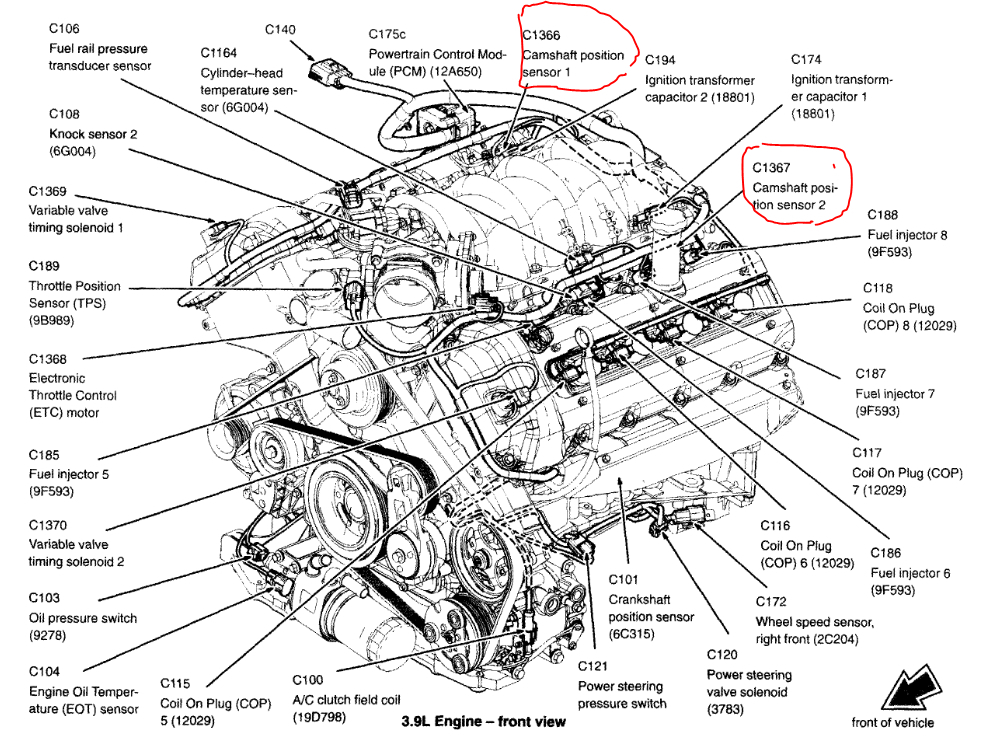
The Camshaft Position Sensor (CMP), a seemingly small component nestled within the intricate landscape of your engine, plays a pivotal role in its smooth and efficient operation. Often overlooked, the CMP sensor is a critical element in modern internal combustion engines, providing crucial data that the Engine Control Unit (ECU) uses to orchestrate the precise timing of fuel injection and ignition. This article will delve into the inner workings of the CMP sensor, examining its construction, function, and its interaction with other engine components. We will explore various sensor types and diagnostic procedures, providing a comprehensive understanding of this often-misunderstood component.
The Role of the Camshaft in Engine Timing
Before we dive into the specifics of the CMP sensor, it's essential to understand the role of the camshaft itself. The camshaft is a rotating shaft with precisely shaped lobes (cams) that actuate the intake and exhaust valves. The camshaft's rotation is directly linked to the crankshaft's rotation, typically at a 1:2 ratio (the camshaft rotates once for every two rotations of the crankshaft in a four-stroke engine). This precise relationship ensures that the valves open and close at the correct moments in the engine's combustion cycle.
Accurate valve timing is paramount for optimal engine performance, fuel efficiency, and emissions control. The ECU needs to know the precise position of the camshaft to synchronize the fuel injection and ignition events with the opening and closing of the valves. This is where the CMP sensor comes into play.
CMP Sensor Types: A Deep Dive
There are primarily two types of CMP sensors in use today: Hall-effect sensors and variable reluctance sensors (also known as inductive sensors). While both achieve the same goal – determining camshaft position – they operate using different principles.
Hall-Effect CMP Sensors
Hall-effect sensors utilize the Hall effect, a phenomenon where a voltage difference (the Hall voltage) is produced across an electrical conductor, transverse to an electric current in the conductor and a magnetic field perpendicular to both. In a Hall-effect CMP sensor, a small semiconductor material carries a constant current. A rotating trigger wheel, often with teeth or windows, is attached to the camshaft. As the trigger wheel rotates, its teeth (or windows) pass by a permanent magnet within the sensor. When a tooth passes, it disrupts the magnetic field, and when a window passes, the magnetic field is restored. These disruptions in the magnetic field generate a voltage pulse, which the ECU interprets as a specific camshaft position.
Diagrammatically, a Hall-effect CMP sensor can be represented as follows:
Key Components:
- Permanent Magnet: Provides a constant magnetic field.
- Semiconductor Material: Carries a constant current and develops the Hall voltage.
- Trigger Wheel (Reluctor Ring): Attached to the camshaft, with teeth or windows.
- Signal Conditioning Circuit: Amplifies and filters the Hall voltage signal for the ECU.
- Connector: Connects the sensor to the vehicle's wiring harness.
Signal Generation: The rotating trigger wheel interacts with the magnetic field. When a tooth passes the sensor, the magnetic field is disrupted, reducing the Hall voltage. When a window passes, the magnetic field is restored, increasing the Hall voltage. This alternating voltage is then processed by the signal conditioning circuit and sent to the ECU as a digital signal (high or low voltage).
Hall-effect sensors require a power supply (typically 5V or 12V) and provide a digital output signal, making them relatively insensitive to variations in engine speed. They are also generally more accurate at low speeds compared to variable reluctance sensors.
Variable Reluctance (Inductive) CMP Sensors
Variable reluctance sensors operate based on the principle of electromagnetic induction. These sensors consist of a coil of wire wrapped around a magnetic core. A trigger wheel, also with teeth or windows, is attached to the camshaft. As the trigger wheel rotates, the teeth passing by the sensor alter the magnetic field around the coil. This change in magnetic flux induces a voltage in the coil, creating an alternating current (AC) signal. The frequency and amplitude of this AC signal are proportional to the camshaft's speed and position.
Diagrammatically, a Variable Reluctance CMP sensor can be represented as follows:
Key Components:
- Magnetic Core: Concentrates the magnetic field.
- Coil of Wire: Generates a voltage when the magnetic field changes.
- Trigger Wheel (Reluctor Ring): Attached to the camshaft, with teeth or windows.
- Connector: Connects the sensor to the vehicle's wiring harness.
Signal Generation: The rotating trigger wheel interacts with the magnetic core. When a tooth passes the sensor, the magnetic reluctance changes, inducing a voltage in the coil. The faster the trigger wheel rotates, the higher the frequency and amplitude of the generated AC signal. The ECU interprets this signal to determine camshaft position.
Unlike Hall-effect sensors, variable reluctance sensors do not require a separate power supply. However, they produce a weaker signal at low speeds, making them potentially less accurate at engine start-up. The amplitude of the signal is also directly proportional to the engine speed, which can make signal processing more complex.
Interpreting the CMP Sensor Signal
Regardless of the sensor type, the ECU receives a signal that represents the camshaft's position. This signal is typically a series of pulses or a sinusoidal waveform. The ECU uses the frequency, amplitude, and phase of this signal to determine the camshaft's angular position with respect to the crankshaft. This information is then used to precisely time the fuel injectors and ignition coils.
For example, in a sequential fuel injection system, the ECU uses the CMP sensor signal to identify which cylinder is in its intake stroke. It then triggers the fuel injector for that specific cylinder, ensuring that fuel is injected only when the intake valve is open. Similarly, the ECU uses the CMP signal to determine when to fire the ignition coil for each cylinder, ensuring that the spark plug ignites the air-fuel mixture at the optimal moment.
Troubleshooting CMP Sensor Issues
A malfunctioning CMP sensor can lead to a variety of engine problems, including:
- Hard starting or no start condition: If the ECU doesn't know the camshaft position, it may be unable to correctly time the fuel injection and ignition, preventing the engine from starting.
- Rough idling: Incorrect valve timing can cause the engine to idle erratically.
- Reduced engine power: Improper fuel injection and ignition timing can result in a loss of power and performance.
- Check engine light illumination: The ECU will typically store a diagnostic trouble code (DTC) if it detects a problem with the CMP sensor signal.
Diagnostic procedures for CMP sensor issues typically involve the following steps:
- Scan for diagnostic trouble codes (DTCs): Use an OBD-II scanner to retrieve any stored DTCs related to the CMP sensor. Common codes include P0340 (Camshaft Position Sensor Circuit Malfunction), P0341 (Camshaft Position Sensor Circuit Range/Performance), and P0342 (Camshaft Position Sensor Circuit Low Input).
- Visually inspect the sensor and wiring: Check for any signs of damage, such as cracked housings, frayed wires, or corroded connectors.
- Test the sensor's wiring: Use a multimeter to check for proper voltage and ground at the sensor connector. Refer to the vehicle's service manual for specific voltage requirements.
- Test the sensor's output signal: Use an oscilloscope or multimeter to measure the sensor's output signal while the engine is running. Compare the signal to the specifications in the vehicle's service manual.
- Check the trigger wheel: Inspect the trigger wheel for any damage or misalignment.
Conclusion
The Camshaft Position Sensor is a vital component in modern engine management systems. By providing precise information about camshaft position, it enables the ECU to accurately control fuel injection and ignition timing, optimizing engine performance, fuel efficiency, and emissions. Understanding the different types of CMP sensors, their operating principles, and common diagnostic procedures is crucial for anyone working on engine systems. A thorough understanding of this small but crucial component can save time and money when diagnosing engine performance issues. Remember to always consult the vehicle's service manual for specific diagnostic procedures and sensor specifications.