
Difference Between Car Wax And Car Polish
The quest for a gleaming, showroom-worthy finish on your vehicle often leads to a crucial crossroads: choosing between car wax and car polish. While both contribute to a better-looking car, they serve distinctly different purposes and should be used in the right order for optimal results. Understanding the difference between these two detailing products is paramount for both the dedicated enthusiast and the professional mechanic.
What is Car Polish?
Car polish, sometimes referred to as a paint compound, is an abrasive product designed to remove imperfections from your car's clear coat. These imperfections can include swirl marks (fine scratches from improper washing techniques), light scratches, oxidation, water spots, and etching from bird droppings or tree sap. The abrasives in polish are incredibly fine, ranging from mild to aggressive depending on the product. They work by leveling the clear coat, effectively removing a microscopic layer to eliminate the imperfections. Think of it like sanding wood – you're removing material to create a smooth surface.
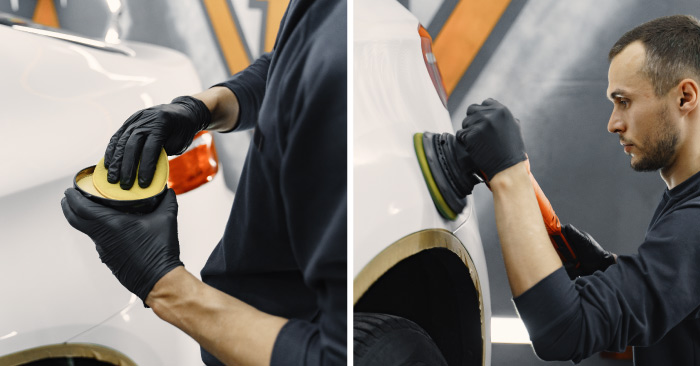
The key ingredient in most polishes is an abrasive, such as aluminum oxide or silicon dioxide. The fineness of the abrasive determines the cutting power of the polish. Heavier cutting compounds are used for more significant imperfections, while finishing polishes are used to refine the surface and remove any hazing left behind by the heavier compounds. Applying polish typically involves using a machine polisher (dual-action or rotary) for best results, although hand application is possible but much more labor-intensive and less effective. Choosing the correct pad for your machine polisher is also critical. Foam pads are typically paired with finishing polishes, while microfiber pads are often used with more aggressive compounds.
Important Note: Polishing removes a small amount of clear coat. Therefore, it should only be done when necessary to correct imperfections. Over-polishing can thin the clear coat to a point where it becomes vulnerable to damage.
What is Car Wax?
Car wax, on the other hand, is a protective coating that is applied *after* polishing. Its primary function is not to correct imperfections, but to protect the freshly polished paint from environmental hazards such as UV rays, rain, dirt, and pollutants. Wax provides a sacrificial layer that takes the brunt of these elements, preserving the clear coat underneath. It also enhances the shine and gloss of the paint, giving your car that deep, wet look that enthusiasts crave.
Waxes come in two main forms: carnauba wax and synthetic wax (sealants). Carnauba wax is a natural wax derived from the leaves of the Brazilian palm tree. It is known for its rich, warm glow and depth of shine. However, carnauba wax is less durable than synthetic waxes and typically needs to be reapplied every few weeks or months. Synthetic waxes, or paint sealants, are man-made polymers that offer superior durability and protection. They can last for several months, even up to a year in some cases. While they may not offer the same depth of shine as carnauba wax, they provide excellent protection against the elements. Some enthusiasts even layer carnauba wax over a sealant for the best of both worlds.
Applying wax is relatively straightforward and can be done by hand using a soft applicator pad. After applying a thin, even layer, the wax is allowed to haze over before being buffed off with a clean microfiber towel.
Key Differences Summarized
Here's a quick breakdown of the key differences:
- Purpose: Polish corrects paint imperfections; wax protects and enhances shine.
- Abrasiveness: Polish is abrasive; wax is not.
- Application: Polish often requires machine application; wax is typically applied by hand.
- Durability: Wax is generally less durable than polish.
- Order of Use: Polish is used *before* wax.
Practical Advice and Real-World Examples
Consider this scenario: a 2018 Honda Civic with noticeable swirl marks from automatic car washes. To restore the paint's clarity, the owner would first need to polish the car using a dual-action polisher and a mild polishing compound. This would remove the swirl marks. Then, to protect the newly polished paint, they would apply a layer of wax, either carnauba or synthetic, to shield it from the elements and enhance the shine. Without polishing, the wax would simply be applied over the swirl marks, masking them temporarily but not correcting them. Without waxing after polishing, the paint would be vulnerable to future damage.
Another example: a classic 1967 Ford Mustang with faded and oxidized paint. In this case, a more aggressive cutting compound may be necessary during the polishing stage to remove the oxidation. This would likely be followed by a finer finishing polish to refine the surface. Finally, a high-quality carnauba wax would be applied to bring out the depth and richness of the paint, adding to the car's vintage appeal.
By understanding the distinct roles of car wax and car polish, you can effectively maintain and protect your vehicle's paint, ensuring it looks its best for years to come.