
Foam Cannon Pressure Washer Attachment
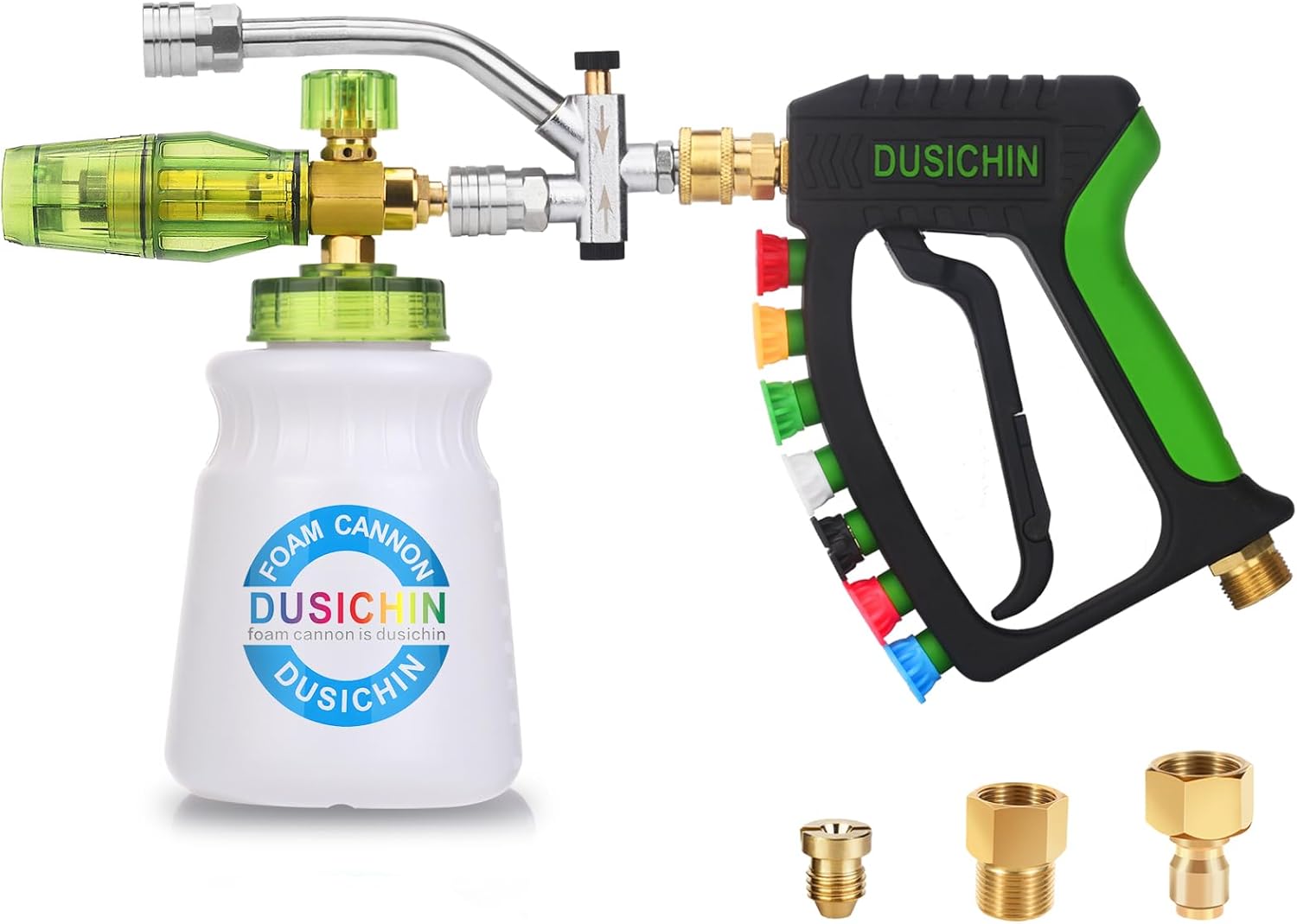
The foam cannon: a seemingly simple attachment that has revolutionized car washing, bringing the spectacle of sudsy snowstorms to driveways around the world. But behind the bubbly curtain lies a fascinating interplay of fluid dynamics, pressure differentials, and material science. This article dives deep into the mechanics of a foam cannon, exploring how it transforms a stream of pressurized water into a thick, clinging blanket of foam.
The Anatomy of a Foam Cannon
Before we dissect the physics, let's identify the key components of a typical foam cannon:
- Intake Nozzle/Orifice: This small opening draws the soap concentrate into the high-pressure water stream. Its size is critical for metering the correct amount of soap.
- Metering Valve/Adjustment Knob: This allows the user to control the soap-to-water ratio. It essentially adjusts the size of the intake orifice or restricts flow to the intake nozzle.
- Body/Reservoir: This holds the concentrated soap solution. Typically made of durable plastic to withstand chemical exposure.
- Venturi Chamber: The heart of the foam generation process. Here, the high-speed water stream creates a vacuum, further drawing in the soap solution.
- Mesh Filter (Internal): Prevents larger particles from entering the system and clogging the nozzle.
- Air Intake: Allows air to be drawn into the mixed solution.
- Foam Nozzle/Outlet: The final stage where the air-soap-water mixture expands and is expelled as foam. Often adjustable to change the spray pattern.
- Pressure Washer Adapter: Connects the foam cannon to the pressure washer wand. A critical connection point that must be compatible with your pressure washer.
The Physics Behind the Foam: Venturi Effect and Bernoulli's Principle
The magic of the foam cannon lies in the application of fundamental physics principles. The Venturi effect, a consequence of Bernoulli's principle, is the key to drawing the soap solution into the water stream. Bernoulli's principle states that as the speed of a fluid increases, its pressure decreases. A Venturi is a constricted passage in a pipe.
Here's how it works inside the foam cannon:
- High-Pressure Water: The pressure washer delivers a high-pressure stream of water into the foam cannon.
- Constriction: The water is forced through a narrow passage within the Venturi chamber. This constriction increases the water's velocity.
- Pressure Drop: As the water speeds up, its pressure drops significantly. This creates a partial vacuum at the point where the soap intake nozzle is located.
- Soap Intake: The pressure difference (higher pressure in the soap reservoir compared to the vacuum in the Venturi) forces the soap concentrate to be drawn into the water stream. This is analogous to how a carburetor in a gasoline engine draws fuel into the airflow.
The concentration of soap in the water stream is determined by the size of the intake orifice and the pressure differential. The metering valve allows you to adjust the orifice size, effectively controlling the amount of soap drawn in. Opening the valve increases the orifice size, allowing more soap to flow into the water stream, resulting in richer foam. Closing the valve reduces the orifice size, decreasing the soap concentration.
The Role of Air Injection
While the Venturi effect mixes the soap and water, it's the introduction of air that transforms the mixture into foam. The air intake allows air to be drawn into the soap-water mixture as it exits the Venturi chamber. This process is critical for creating the stable, long-lasting foam we desire.
The air mixes with the soapy water, creating countless tiny bubbles. The soap molecules act as surfactants, reducing the surface tension of the water and stabilizing the bubbles. Without soap, the bubbles would quickly coalesce and collapse.
The design of the foam nozzle plays a crucial role in air injection and foam quality. Some nozzles incorporate baffles or diffusers to further break up the liquid stream and promote air mixing. The adjustable pattern of the nozzle allows users to choose between a wide fan spray for covering large areas quickly or a narrow, concentrated stream for focused cleaning.
Foam Quality: Factors and Optimizations
Achieving optimal foam quality depends on several factors, including:
- Soap Concentrate: The type of soap used significantly impacts foam generation. Dedicated foam cannon soaps are specially formulated with high surfactant concentrations and foaming agents. Dish soap, while readily available, is generally not suitable for foam cannons as it lacks the necessary properties.
- Water Hardness: Hard water (water with high mineral content) can interfere with soap's ability to create stable foam. The minerals bind to the surfactant molecules, reducing their effectiveness. Using a water softener or deionized water can improve foam quality in hard water areas.
- Pressure Washer Pressure: The pressure washer's output pressure directly affects the water velocity in the Venturi chamber. Higher pressure generally results in better foam generation, up to a certain point. Exceeding the foam cannon's recommended pressure rating can damage the unit or reduce its effectiveness.
- Soap-to-Water Ratio: Finding the ideal soap-to-water ratio is crucial. Too little soap will result in thin, watery foam, while too much soap can leave a residue on the vehicle's surface. Experimentation is key to finding the optimal setting for your specific soap and water conditions.
- Air Intake: Ensuring the air intake is not blocked or obstructed is essential for proper air mixing. Some foam cannons have adjustable air intakes, allowing you to fine-tune the foam consistency.
Optimizing these factors can dramatically improve foam quality, resulting in a thicker, longer-lasting foam that effectively lifts dirt and grime from the vehicle's surface.
Material Science and Durability
Foam cannons are exposed to harsh chemicals and high pressures, so material selection is critical for durability and longevity. The reservoir is typically made from high-density polyethylene (HDPE) or polypropylene (PP), which are resistant to chemical degradation. The internal components, such as the Venturi chamber and nozzles, are often made from brass or stainless steel to withstand the constant flow of pressurized water.
The seals and O-rings are typically made from nitrile rubber (NBR) or Viton, which are resistant to swelling and degradation from exposure to soap and water. Proper maintenance, including rinsing the foam cannon after each use and periodically lubricating the seals, can significantly extend its lifespan.
Troubleshooting Common Issues
Even with proper care, foam cannons can occasionally experience issues. Here are some common problems and their potential solutions:
- No Foam or Weak Foam:
Possible causes: Low pressure from pressure washer, clogged intake nozzle, incorrect soap-to-water ratio, hard water, blocked air intake, defective soap.
Solutions: Increase pressure washer pressure (within the foam cannon's rating), clean the intake nozzle with a small wire or needle, adjust the soap-to-water ratio, use a water softener, ensure the air intake is clear, try a different soap concentrate.
- Foam Cannon Leaking:
Possible causes: Damaged or worn O-rings, loose connections, cracked reservoir.
Solutions: Replace damaged O-rings, tighten connections, replace the reservoir if cracked.
- Inconsistent Foam:
Possible causes: Fluctuating water pressure, partially clogged intake nozzle, inconsistent soap concentration.
Solutions: Ensure a stable water supply to the pressure washer, clean the intake nozzle thoroughly, premix the soap concentrate with water before adding it to the reservoir.
Beyond Car Washing: Alternative Applications
While primarily used for car washing, foam cannons have found applications in other areas, including:
- House Washing: Applying cleaning solutions to siding and other exterior surfaces.
- Deck Cleaning: Removing dirt and algae from decks and patios.
- Agricultural Applications: Applying pesticides and herbicides to crops.
- Sanitizing Surfaces: Disinfecting surfaces with appropriate cleaning solutions.
In these applications, the foam cannon provides a convenient and efficient way to apply cleaning solutions evenly and thoroughly. However, it's crucial to use appropriate chemicals and follow safety precautions when using foam cannons for purposes other than car washing.
Conclusion
The foam cannon, a seemingly simple device, is a testament to the power of applied physics and engineering. By understanding the principles of the Venturi effect, air injection, and material science, we can appreciate the ingenuity behind this popular car washing tool. With proper care and maintenance, a foam cannon can provide years of service, transforming car washing from a chore into a satisfying and visually impressive experience. So, the next time you blanket your car in a thick layer of foam, take a moment to appreciate the clever engineering that makes it all possible. Happy detailing!