
Location Of Idle Control Valve
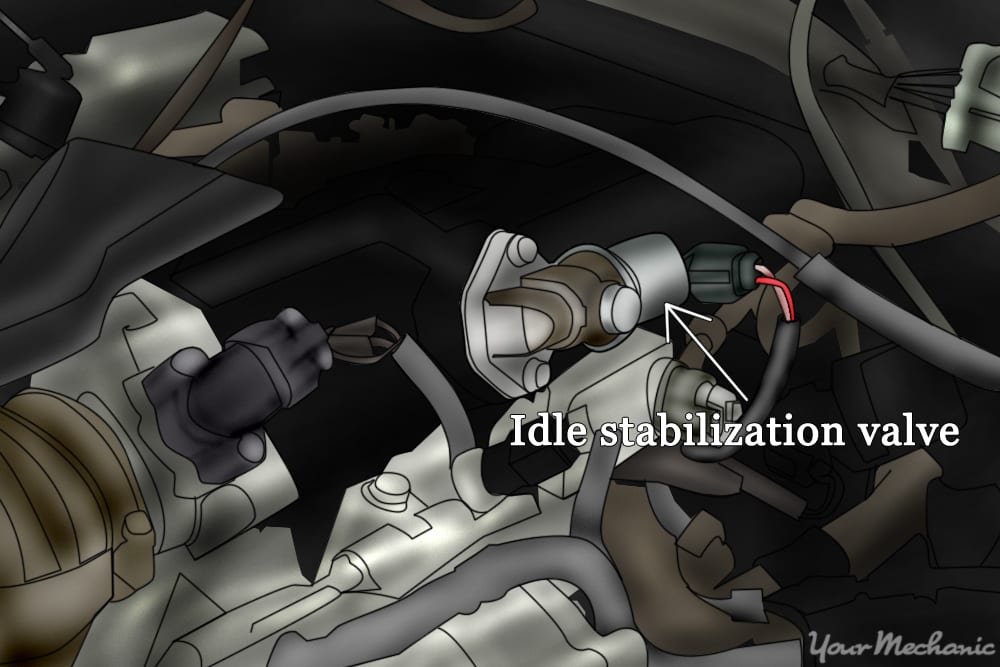
The Idle Air Control (IAC) valve, sometimes called the Idle Speed Control (ISC) valve, is a critical component in modern internal combustion engines. Its primary function is to regulate the engine's idle speed, ensuring a smooth and stable running condition when the driver isn't pressing the accelerator pedal. While the basic function remains consistent across different vehicles, the precise location of the IAC valve can vary significantly depending on the manufacturer, engine type, and model year. Understanding these variations is crucial for diagnosis, maintenance, and repair.
General Location Principles
Before diving into specific examples, it's helpful to understand the general principles that dictate IAC valve placement. The valve needs to be positioned in a location where it can effectively bypass the throttle plate, allowing a controlled amount of air to enter the intake manifold, even when the throttle is closed. This bypass air supplements the minimal leakage past the closed throttle, preventing the engine from stalling.
Several factors influence the final location:
- Intake Manifold Design: The overall design of the intake manifold is a major determinant. Manufacturers often integrate the IAC valve directly into the manifold casting or attach it to a dedicated port.
- Throttle Body Type: The throttle body, responsible for controlling the main airflow into the engine, frequently houses the IAC valve. In some cases, the valve is bolted directly to the throttle body, while in others, it's integrated internally.
- Engine Management System (EMS): The complexity and sophistication of the engine management system can influence the choice of IAC valve location. More advanced systems might require more precise airflow control, leading to more strategically placed valves.
- Packaging Constraints: The available space within the engine bay is a constant challenge for automotive engineers. The IAC valve must be located in a way that doesn't interfere with other components or make maintenance unnecessarily difficult.
Common IAC Valve Locations: A Detailed Overview
Let's examine some of the most common locations for IAC valves, along with examples of vehicles where they can be found:
1. Throttle Body Mounted (External)
This is perhaps the most frequently encountered location. The IAC valve is bolted directly to the throttle body, usually on the side or top. It's typically secured with two or three bolts and connected to the engine wiring harness via an electrical connector. An external IAC valve is often easily identifiable by its cylindrical or rectangular shape.
Example: Many older GM vehicles (Chevrolet, Pontiac, Buick) with throttle body injection (TBI) or early multi-port fuel injection (MPFI) systems used externally mounted IAC valves. Similarly, some Ford vehicles from the 1990s and early 2000s also feature this design. Look for a small, black cylinder attached to the throttle body.
Advantages: Relatively easy access for inspection, cleaning, and replacement. The external mounting simplifies manufacturing and assembly.
Disadvantages: Can be more susceptible to environmental contamination, as it's exposed to the elements.
2. Integrated Within the Throttle Body (Internal)
In this design, the IAC valve is housed internally within the throttle body casting. The valve itself isn't directly visible, but there will typically be an electrical connector leading to the throttle body, indicating its presence. The internal design offers better protection from the environment.
Example: Many modern Honda and Toyota vehicles utilize integrated IAC valves within their throttle bodies. Finding the connector is the key here, as the valve itself will be hidden.
Advantages: Better protection from the elements. More compact design, saving space in the engine bay.
Disadvantages: More difficult to access for cleaning or replacement. Requires disassembling the throttle body for service in some cases.
3. Mounted on the Intake Manifold
Some manufacturers choose to mount the IAC valve directly onto the intake manifold, often near the throttle body connection point. In this configuration, the IAC valve draws air directly from the intake air stream before the throttle plate.
Example: Certain Chrysler and Jeep vehicles with inline or V6 engines might have the IAC valve mounted on the intake manifold, usually towards the rear of the manifold near the firewall.
Advantages: Can provide more stable idle control by drawing air from a more consistent source.
Disadvantages: Can be more difficult to access depending on the intake manifold design and surrounding components.
4. Remote Mounted
Although less common, some vehicles employ a remotely mounted IAC valve. In this scenario, the valve is physically separated from both the throttle body and the intake manifold. It's connected to these components via hoses or tubes that carry the bypass air.
Example: Some older Volvo models and certain European vehicles have used remote-mounted IAC valves, often tucked away in less accessible areas of the engine bay.
Advantages: Allows for greater flexibility in valve placement, potentially optimizing airflow or simplifying engine bay layout.
Disadvantages: More complex system with additional hoses and connections, increasing the potential for leaks and malfunctions. Can be the most difficult to locate.
Identifying the IAC Valve: Key Visual Cues
Even with the information above, locating the IAC valve can still be challenging. Here are some key visual cues to help you identify it:
- Electrical Connector: The IAC valve will always have an electrical connector that provides power and control signals from the engine control unit (ECU). Look for a connector with two or more wires leading to a small device near the throttle body or intake manifold.
- Air Passages: The IAC valve needs to have air passages to allow bypass air to flow. Look for small holes or ports on the valve body that connect to the intake manifold or throttle body.
- Step Motor/Solenoid: Most IAC valves use a stepper motor or solenoid to control the amount of air that bypasses the throttle plate. You might be able to see the motor or solenoid housing on the valve body.
- Service Manual/Wiring Diagram: If you're unsure, consult the vehicle's service manual or wiring diagram. These resources will provide detailed information about the IAC valve location and wiring.
Troubleshooting Idle Problems: The IAC Valve's Role
The IAC valve is a common culprit in idle-related problems. Symptoms of a malfunctioning IAC valve can include:
- Rough or unstable idle
- Stalling at idle
- High idle speed
- Erratic idle speed
Before replacing the IAC valve, it's essential to diagnose the problem correctly. Check for vacuum leaks, clean the throttle body and IAC valve passages, and test the valve's electrical connections. A faulty IAC valve can often be diagnosed with a scan tool that can monitor the valve's position and control its operation.
Conclusion
The location of the Idle Air Control valve is a detail dependent on the specific vehicle. However, by understanding the principles of its operation, common location patterns, and visual cues, you can effectively locate and diagnose problems related to this essential component. Remember to consult your vehicle's service manual for the most accurate information.