
Nissan Cvt Transmission Fluid Capacity
Continuously Variable Transmissions (CVTs) have become increasingly common in Nissan vehicles due to their ability to offer smooth acceleration and improved fuel economy. However, maintaining a CVT requires careful attention to the transmission fluid. Knowing the correct fluid capacity and how to check/change it is crucial for longevity. This article will delve into the specifics of Nissan CVT fluid capacity, covering different models, fluid types, and procedures.
Understanding Nissan CVT Fluid
Before we dive into capacities, let's discuss the fluid itself. Nissan CVTs are highly sensitive to the type of fluid used. Do not substitute with generic transmission fluid. Using the wrong fluid can lead to serious damage and costly repairs. Nissan specifies its own CVT fluids, primarily:
- NS-1: Older models. Becoming less common.
- NS-2: Also used in older models, but not interchangeable with NS-1.
- NS-3: The most common fluid for newer Nissan CVTs (typically post-2013).
- NS-CVT FE (NS-3 FE): A low-viscosity fluid designed for improved fuel efficiency in some newer models. It's crucial to verify compatibility.
Always consult your vehicle's owner's manual or a reliable parts catalog to determine the correct CVT fluid for your specific model and year. Using the wrong fluid can cause slippage, shuddering, and even complete transmission failure.
Technical Note: The different NS fluids have varying friction modifiers and viscosity characteristics. These are engineered to work specifically with the belt and pulley system of the CVT. Substituting with a generic fluid that doesn't match these specifications can drastically alter the transmission's performance and lifespan.
Nissan CVT Fluid Capacity: By Model
Determining the exact fluid capacity can be tricky, as it varies depending on the model, year, and whether you're performing a simple drain and refill or a complete transmission overhaul. The listed capacities are approximate and serve as a guideline. Always use the dipstick (if equipped) or the proper fill level check procedure (as outlined in the service manual) to ensure the correct level.
Here's a breakdown of fluid capacities for some common Nissan models. Remember to double-check your owner's manual for the most accurate information.
Nissan Altima
- 2007-2012 (QR25DE 2.5L): Approximately 4.0-4.5 quarts (drain and refill). Total fill after rebuild may be closer to 9-10 quarts. NS-2 fluid is typically specified.
- 2013-2018 (QR25DE 2.5L): Approximately 4.0-4.5 quarts (drain and refill). Total fill after rebuild may be closer to 9-10 quarts. NS-3 fluid is typically specified.
- 2019+ (PR25DD 2.5L): Approximately 4.0-4.5 quarts (drain and refill). Check owner's manual to confirm NS-3 or NS-CVT FE specification.
Nissan Rogue
- 2008-2013 (QR25DE 2.5L): Approximately 4.0-4.5 quarts (drain and refill). Total fill after rebuild may be closer to 9-10 quarts. NS-2 fluid is typically specified.
- 2014-2020 (QR25DE 2.5L): Approximately 4.0-4.5 quarts (drain and refill). Total fill after rebuild may be closer to 9-10 quarts. NS-3 fluid is typically specified.
- 2021+ (PR25DD 2.5L): Approximately 4.0-4.5 quarts (drain and refill). Check owner's manual to confirm NS-3 or NS-CVT FE specification.
Nissan Sentra
- 2007-2012 (MR20DE 2.0L): Approximately 4.0-4.5 quarts (drain and refill). Total fill after rebuild may be closer to 9-10 quarts. NS-2 fluid is typically specified.
- 2013-2019 (MRA8DE 1.8L): Approximately 4.0-4.5 quarts (drain and refill). Total fill after rebuild may be closer to 9-10 quarts. NS-3 fluid is typically specified.
- 2020+ (MR20DD 2.0L): Approximately 4.0-4.5 quarts (drain and refill). Check owner's manual to confirm NS-3 or NS-CVT FE specification.
Nissan Murano
- 2003-2014 (VQ35DE 3.5L): Approximately 4.5-5.0 quarts (drain and refill). Total fill after rebuild may be closer to 10-11 quarts. NS-2 fluid is typically specified.
- 2015+ (VQ35DE 3.5L): Approximately 4.5-5.0 quarts (drain and refill). Total fill after rebuild may be closer to 10-11 quarts. NS-3 fluid is typically specified.
Nissan Pathfinder
- 2013-2020 (VQ35DD 3.5L): Approximately 4.5-5.0 quarts (drain and refill). Total fill after rebuild may be closer to 10-11 quarts. NS-3 fluid is typically specified.
Important Note: These are just a few examples. Fluid capacities can vary even within the same model year depending on the specific transmission variant. Always refer to your vehicle's service manual for the definitive fluid capacity and proper filling procedure.
Checking and Changing Nissan CVT Fluid
Checking and changing your Nissan CVT fluid is a crucial maintenance task. Here's a general overview, but always consult your vehicle's service manual for specific instructions.
Checking the Fluid Level
Some Nissan CVTs have a dipstick for checking the fluid level, while others require a more involved procedure involving a fill plug and an overflow tube.
With Dipstick:
- Park the vehicle on a level surface.
- Warm up the engine to operating temperature.
- With the engine running, shift through all gear positions (P, R, N, D) pausing briefly in each.
- Return the transmission to Park (P).
- Locate the CVT dipstick (usually marked).
- Remove the dipstick and wipe it clean.
- Reinsert the dipstick fully.
- Remove the dipstick again and check the fluid level. It should be within the "HOT" range on the dipstick.
Without Dipstick (Level Check Plug):
- Park the vehicle on a level surface.
- Warm up the engine to operating temperature (follow the procedure in the service manual, which may involve specific driving conditions).
- With the engine running and the transmission in Park (P), remove the check plug (usually located on the side of the transmission pan).
- The fluid should trickle out slowly. If no fluid comes out, the level is too low. If a large amount comes out, the level is too high.
- Add or remove fluid as needed through the fill plug until a slow trickle is observed from the check plug.
- Reinstall the check plug to the specified torque.
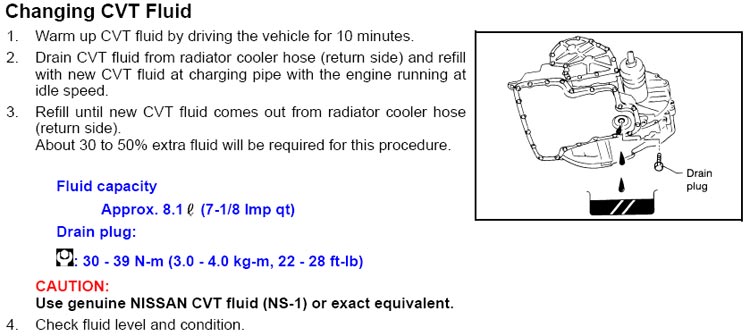
Changing the Fluid (Drain and Refill)
A drain and refill replaces only a portion of the fluid in the transmission. It's a good preventative maintenance procedure. A full fluid exchange (flushing) is generally not recommended for Nissan CVTs unless specifically outlined in the service manual, as it can dislodge debris and cause problems.
- Park the vehicle on a level surface and allow the engine and transmission to cool.
- Locate the transmission drain plug (usually on the bottom of the transmission pan).
- Place a drain pan underneath the drain plug.
- Remove the drain plug and allow the fluid to drain completely.
- Reinstall the drain plug with a new crush washer (if applicable) to the specified torque.
- Locate the transmission fill plug. This may be accessible from under the hood or from under the vehicle.
- Using a funnel, add the appropriate amount of new CVT fluid (as determined earlier in this article, and confirmed in your service manual).
- Check the fluid level using the procedure outlined above (with or without a dipstick, depending on your vehicle).
- Adjust the fluid level as needed.
- Drive the vehicle briefly and recheck the fluid level.
Important Considerations:
- Torque Specs: Always use a torque wrench and tighten drain and fill plugs to the specified torque in the service manual. Overtightening can damage the threads.
- Crush Washers: Replace crush washers on drain plugs to ensure a proper seal.
- Fluid Temperature: Some fluid level check procedures require the fluid to be within a specific temperature range. Use a scan tool to monitor the transmission fluid temperature if necessary.
- Proper Disposal: Dispose of used transmission fluid properly at a recycling center or auto parts store.
- Filter Replacement: Some Nissan CVTs have an external filter that should be replaced during fluid changes. Refer to your service manual.
Troubleshooting Common CVT Issues
If you're experiencing problems with your Nissan CVT, such as:
- Shuddering or Jerking: Often caused by low fluid level or contaminated fluid.
- Slipping: Can be due to worn CVT belt or incorrect fluid.
- Whining Noise: May indicate low fluid level or internal damage.
- Transmission Failure: Often a result of neglected maintenance or using the wrong fluid.
...it's crucial to address the issue promptly. Start by checking the fluid level and condition. If the fluid is dark, burnt, or contains debris, a fluid change is likely needed. If the problem persists, consult a qualified transmission specialist.
Conclusion
Proper CVT fluid maintenance is essential for the longevity and performance of your Nissan vehicle. By understanding the correct fluid type, capacity, and checking/changing procedures, you can help prevent costly repairs and ensure your CVT operates smoothly for years to come. Always prioritize the information in your vehicle's owner's manual and service manual, and don't hesitate to consult a qualified mechanic if you're unsure about any aspect of CVT maintenance.