
Nissan Titan Crankshaft Position Sensor Location
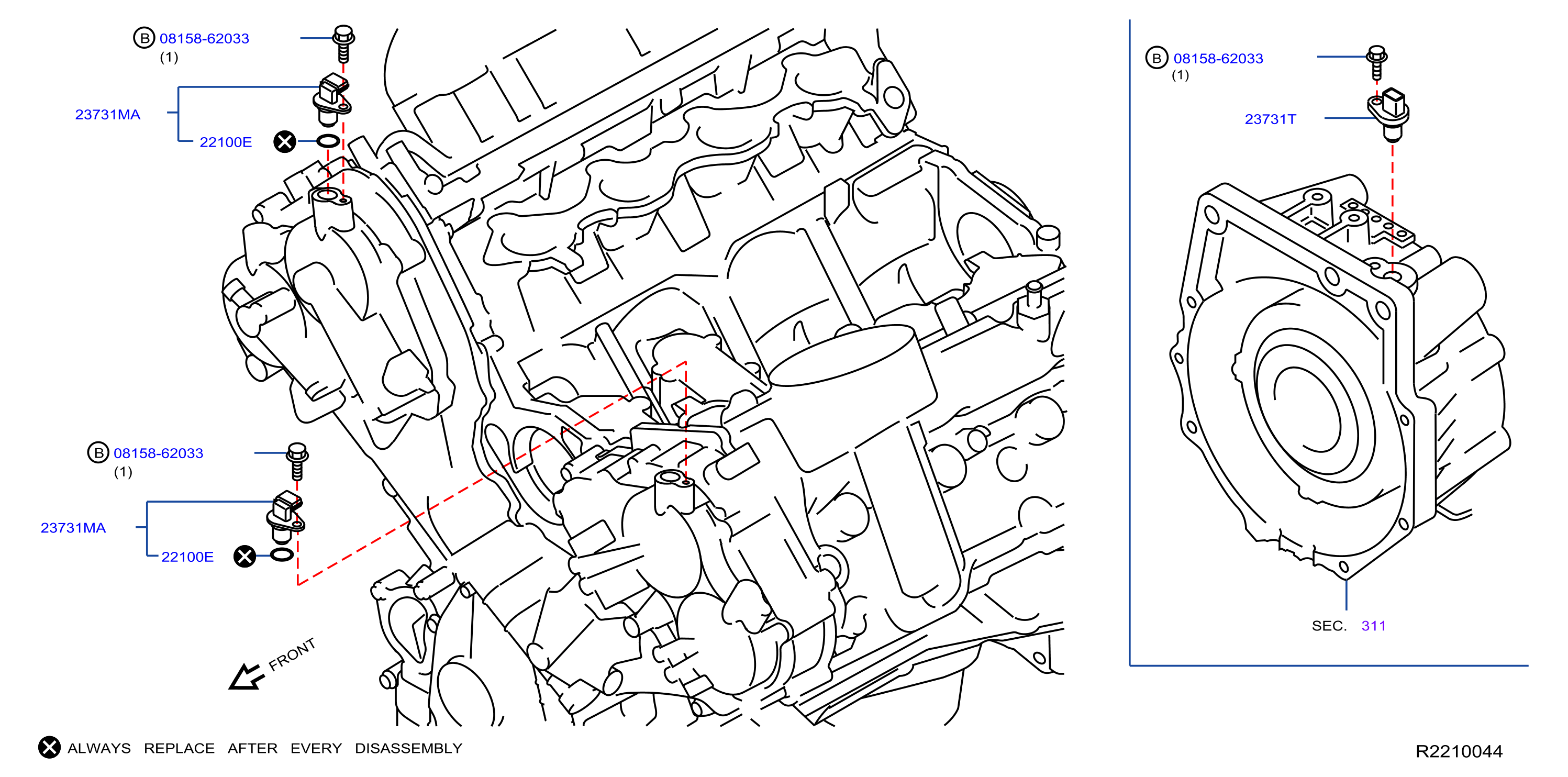
The Crankshaft Position Sensor (CKP sensor) is a vital component in modern internal combustion engines, including those powering the Nissan Titan. Think of it as the engine's timekeeper, diligently monitoring the crankshaft's position and sending this crucial data to the Engine Control Unit (ECU), often referred to as the engine's 'brain'. This information is essential for proper ignition timing, fuel injection, and overall engine performance. If the CKP sensor malfunctions, your Titan can experience a range of issues, from rough idling to a complete no-start condition.
Understanding the Crankshaft Position Sensor
Before diving into the specific location of the CKP sensor on your Nissan Titan, let's establish a clear understanding of its function. The crankshaft is the rotating backbone of your engine. As the pistons move up and down, they turn the crankshaft, which ultimately delivers power to the wheels. The CKP sensor's job is to precisely track the crankshaft's rotational speed (RPM) and its exact position at any given moment.
How does it do this? Most CKP sensors are based on either a magnetic reluctance or Hall effect principle. In the case of magnetic reluctance, the sensor works with a reluctor wheel (also called a trigger wheel or tone ring) that is mounted on the crankshaft. This wheel has teeth or notches. As the crankshaft rotates, these teeth pass by the sensor, creating changes in the magnetic field. These changes generate a voltage signal that the ECU interprets as the crankshaft's position.
Hall effect sensors, on the other hand, use a semiconductor element that produces a voltage proportional to the magnetic field applied to it. A magnet is often incorporated into the sensor itself. As the reluctor wheel rotates, it interrupts the magnetic field, causing changes in the Hall effect sensor's voltage output. Again, this voltage signal is read by the ECU.
The ECU uses the CKP sensor data to determine when to fire the spark plugs and inject fuel into the cylinders. Precise timing is critical for optimal combustion, fuel efficiency, and emissions control. If the CKP sensor provides inaccurate or intermittent signals, the ECU will struggle to manage these processes effectively.
Locating the CKP Sensor on a Nissan Titan
Now, let's get to the heart of the matter: where to find the CKP sensor on your Nissan Titan. The exact location can vary slightly depending on the engine and model year, but it is usually found near the rear of the engine block, close to the transmission bellhousing. It's typically positioned to sense the reluctor wheel, which is integrated into the crankshaft.
Here's a more detailed breakdown and considerations:
- General Area: Look around the area where the engine and transmission meet. You'll be searching the lower portion of the engine block.
- Sensor Appearance: The CKP sensor is typically a small, cylindrical or rectangular component with a wiring connector attached. It's often black or dark gray in color.
- Reluctor Wheel: The sensor will be positioned very close to the crankshaft reluctor wheel (sometimes called a tone ring). The reluctor wheel is a circular metal disc with teeth or notches. You might not see the reluctor wheel directly without removing the sensor.
- Bolting and Accessibility: The CKP sensor is typically held in place by a single bolt. Accessing it might require removing other components, such as heat shields or wiring harnesses, to gain a clear view and reach the sensor.
Example: Think of locating the CKP sensor similarly to finding the Camshaft Position Sensor (CMP) on many cars. While the CMP monitors the camshaft's position, and is usually located on the cylinder head, both are typically small sensors near rotating components and often secured with a single bolt. On a Honda Civic, the CMP is usually on the side of the cylinder head, near the timing belt cover. The CKP on the Titan is similar in its mounting style, just located near the crankshaft.
Specific Model Year Variations
While the general location remains consistent, minor variations can exist between different Nissan Titan model years. For instance:
- 2004-2015 Titans (VK56DE Engine): The CKP sensor is generally located on the driver's side rear of the engine block, near the transmission bellhousing. Access might be slightly obstructed by exhaust components.
- 2016-Present Titans (VK56VD Engine): Similar location to the earlier models, but the exact positioning and accessibility might be different due to changes in the engine design and surrounding components.
Always consult your vehicle's service manual for the most accurate and specific location information. This manual will provide detailed diagrams and instructions tailored to your particular Titan model and year. Many online Nissan parts websites also show exploded diagrams that can help pinpoint the CKP sensor location.
Symptoms of a Faulty CKP Sensor
A failing CKP sensor can manifest in various ways, and recognizing these symptoms can help you diagnose the problem quickly:
- Engine Stalling: The engine might stall intermittently, especially when it's warm.
- Rough Idling: The engine might idle roughly or erratically.
- Hard Starting or No Start: The engine might be difficult to start, or it might not start at all.
- Check Engine Light (CEL): The CEL will likely illuminate, and diagnostic trouble codes (DTCs) related to the CKP sensor (e.g., P0335, P0336, P0337) will be stored in the ECU.
- Reduced Engine Performance: The engine might feel sluggish or lack power.
- Hesitation or Misfires: You might experience hesitation during acceleration or engine misfires.
Example: Imagine your Titan is behaving like an old Ford F-150 with a worn distributor. The engine sputters, stalls at idle, and generally runs poorly. While the F-150's issues might stem from the distributor, in your Titan, the CKP sensor is a prime suspect.
Testing the CKP Sensor
Before replacing the CKP sensor, it's wise to test it to confirm that it's indeed the source of the problem. Here's a simplified approach:
- Visual Inspection: Check the sensor and its wiring for any obvious damage, such as cracks, frayed wires, or corrosion.
- Resistance Test: Use a multimeter to measure the resistance of the sensor. Compare the reading to the specifications in your vehicle's service manual. An open circuit or a short circuit indicates a faulty sensor.
- Voltage Test (AC Signal): While the engine is cranking, use a multimeter to measure the AC voltage output of the sensor. The voltage should fluctuate as the crankshaft rotates. Lack of signal or an erratic signal suggests a problem. Important: Be extremely careful when testing electrical components with the engine running.
Remember to disconnect the battery before performing any electrical testing to prevent accidental shorts or damage.
Note: Some advanced diagnostic tools can read the CKP sensor signal directly and display it on a graph. This allows for a more in-depth analysis of the sensor's performance.
Replacing the CKP Sensor
If the CKP sensor is faulty, replacing it is usually a straightforward process. However, always refer to your vehicle's service manual for specific instructions and torque specifications. Here's a general overview:
- Disconnect the Battery: This is a crucial safety step.
- Locate the CKP Sensor: Refer to the information above.
- Disconnect the Wiring Connector: Carefully disconnect the wiring connector from the sensor.
- Remove the Mounting Bolt: Remove the bolt that secures the sensor to the engine block.
- Remove the Old Sensor: Gently pull the old sensor out of its mounting hole.
- Install the New Sensor: Install the new sensor, ensuring that it's properly seated.
- Install the Mounting Bolt: Tighten the mounting bolt to the specified torque.
- Reconnect the Wiring Connector: Reconnect the wiring connector to the sensor.
- Reconnect the Battery: Reconnect the battery.
- Clear Diagnostic Trouble Codes (DTCs): Use a scan tool to clear any DTCs that were stored in the ECU.
- Test Drive: Test drive the vehicle to ensure that the engine is running smoothly.
Practical Takeaways
Here's what you should remember about the Nissan Titan CKP sensor:
- Importance: The CKP sensor is critical for engine timing and performance.
- Location: It's usually found near the rear of the engine block, close to the transmission bellhousing.
- Symptoms: Be aware of the symptoms of a faulty CKP sensor, such as stalling, rough idling, and hard starting.
- Testing: Test the sensor before replacing it to confirm the diagnosis.
- Service Manual: Always consult your vehicle's service manual for specific instructions and torque specifications.
- Safety First: Disconnect the battery before performing any electrical work.
By understanding the function, location, and troubleshooting of the CKP sensor on your Nissan Titan, you can better maintain your vehicle and address potential engine problems effectively. This knowledge empowers you to either perform the repair yourself or communicate more effectively with your mechanic, saving you time and money.