
Nissan Versa 4 Cylinder Firing Order
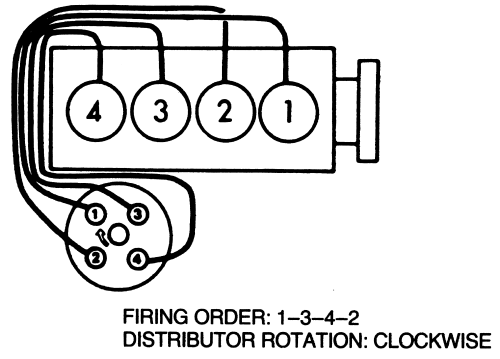
Understanding the firing order of your engine is fundamental to diagnosing and resolving many performance issues. For Nissan Versa owners and enthusiasts, knowing the specific firing order of its 4-cylinder engine can be invaluable. This article aims to demystify this often-overlooked aspect of engine mechanics, providing clear explanations, relatable examples, and practical takeaways.
What is Firing Order, and Why Does it Matter?
The firing order is the sequence in which the cylinders of an internal combustion engine fire. It dictates the order in which the spark plugs ignite the air-fuel mixture in each cylinder. It’s not a random process; it's meticulously engineered to ensure balanced engine operation, minimize vibrations, and optimize power delivery.
Think of it like a drummer in a band. If the drummer hits the drums randomly, you'll get noise, not music. Similarly, if the cylinders fire in a haphazard way, the engine will run poorly, vibrate excessively, and potentially suffer damage. The firing order is the engine's rhythmic sequence, ensuring each cylinder contributes its power in a balanced and coordinated manner.
Why does it matter? A correct firing order is crucial for:
- Smooth Engine Operation: A balanced firing sequence minimizes vibrations and ensures a smoother ride.
- Optimal Performance: Firing the cylinders in the correct order maximizes power output and fuel efficiency.
- Reduced Wear and Tear: A balanced engine reduces stress on internal components, extending engine life.
- Accurate Diagnostics: Knowing the firing order is essential for diagnosing misfires and other engine-related problems.
The Nissan Versa 4-Cylinder Firing Order
The Nissan Versa, equipped with its 4-cylinder engine (typically a 1.6L or 1.8L, depending on the year and model), uses a standard firing order of 1-3-4-2. This means that cylinder number one fires first, followed by cylinder number three, then cylinder number four, and finally cylinder number two. This sequence repeats continuously as the engine runs.
It's important to remember that this is the standard firing order. While highly unlikely for a stock Versa engine, modifications or swaps could potentially alter this. Always verify the firing order against your specific engine configuration if any modifications have been performed.
Identifying Cylinder Numbers
Before you can apply the firing order, you need to know how the cylinders are numbered. On most inline 4-cylinder engines, including the Versa's, the cylinders are numbered sequentially from front to back, starting with cylinder number one at the end closest to the drive belt (the side where the pulleys and accessories are located). So, looking at the engine from the front of the car, the cylinders would be numbered (from left to right):
Front of Car  →
Cylinder 1 - Cylinder 2 - Cylinder 3 - Cylinder 4
Think of a BMW inline-6 engine, for example. The same principle applies; the cylinders are numbered sequentially from front to back. Understanding this numbering convention is essential across various engine types.
Relating Firing Order to Distributor Cap Position (If Applicable)
While newer Nissan Versa models don't use a traditional distributor cap, understanding the concept is helpful for older vehicles and provides a broader understanding of ignition systems. In vehicles with a distributor, the spark plug wires are connected to the distributor cap in a specific order, corresponding to the engine's firing order. The rotor inside the distributor cap rotates, directing the spark to the correct cylinder at the correct time.
If your Versa, or a classic car you might be working on, does have a distributor, you would need to identify the terminal on the distributor cap that corresponds to cylinder number one. From there, you would connect the remaining spark plug wires to the terminals in the order of 1-3-4-2, either clockwise or counterclockwise depending on the distributor's rotation. Consult your vehicle's service manual for the correct distributor cap layout and rotation direction.
For example, in an older Chevrolet small-block V8 with a firing order of 1-8-4-3-6-5-7-2, the spark plug wires would be connected to the distributor cap in that specific sequence. Misplacing even one wire would result in a severe misfire.
Common Problems Associated with Incorrect Firing Order
An incorrect firing order can lead to a variety of noticeable problems:
- Engine Misfires: This is the most common symptom. The engine will run rough, and you may feel vibrations. A misfire occurs when a cylinder doesn't fire properly, leading to incomplete combustion.
- Loss of Power: The engine will feel sluggish and unresponsive.
- Poor Fuel Economy: The engine will be less efficient, consuming more fuel.
- Rough Idling: The engine will idle erratically and may stall.
- Check Engine Light: The engine control unit (ECU) will likely detect the misfire and illuminate the check engine light. Diagnostic trouble codes (DTCs) such as P0300 (random misfire), P0301 (misfire cylinder 1), etc., may be stored.
- Backfiring: In severe cases, the engine may backfire through the intake or exhaust.
If you experience any of these symptoms, double-checking the firing order should be one of your first troubleshooting steps. Think of it as the automotive equivalent of "Did you plug it in?" It's a simple check that can save you a lot of time and frustration.
Practical Takeaways: Applying This Knowledge
Here's how you can use this knowledge in practical scenarios:
- Troubleshooting Misfires: If you suspect a misfire, use an OBD-II scanner to read diagnostic trouble codes. If the code indicates a specific cylinder is misfiring (e.g., P0302 for cylinder 2), check the spark plug, ignition coil, and fuel injector for that cylinder. Verify that the spark plug wire (if applicable) is connected correctly according to the 1-3-4-2 firing order.
- Replacing Spark Plugs: When replacing spark plugs, ensure you reconnect the spark plug wires (if applicable) in the correct order. It's a good practice to replace the wires one at a time to avoid confusion. Labeling the wires before removal can also be helpful.
- Performing Engine Maintenance: Understanding the firing order is crucial for various engine maintenance tasks, such as timing adjustments and valve adjustments. Consult your vehicle's service manual for specific procedures.
- Swapping Ignition Coils: If diagnosing a misfire and you suspect a faulty ignition coil (common in newer Versa models with coil-on-plug ignition), you can swap the coil from the suspected cylinder with a coil from a known good cylinder. If the misfire moves to the new cylinder, you've confirmed the faulty coil. Remember to disconnect the battery before working on the electrical system.
- Understanding Engine Design: Knowing the firing order provides a deeper understanding of how the engine operates and how its various components interact. This knowledge can be invaluable for diagnosing and resolving a wide range of engine-related problems.
"An ounce of prevention is worth a pound of cure." Regularly inspecting your engine's ignition system, including spark plugs and wires (if applicable), can help prevent firing order-related problems. A clean and properly maintained ignition system ensures optimal engine performance and fuel efficiency.
In conclusion, while modern engine management systems are sophisticated, the fundamental principles of engine operation, including the firing order, remain crucial for understanding and maintaining your Nissan Versa. By understanding the 1-3-4-2 firing order of your Versa's 4-cylinder engine, you can troubleshoot misfires, perform routine maintenance, and gain a deeper appreciation for the inner workings of your vehicle. Remember to consult your vehicle's service manual for specific procedures and always prioritize safety when working on your car.