
Oxygen Sensor Output Voltage B1-s1
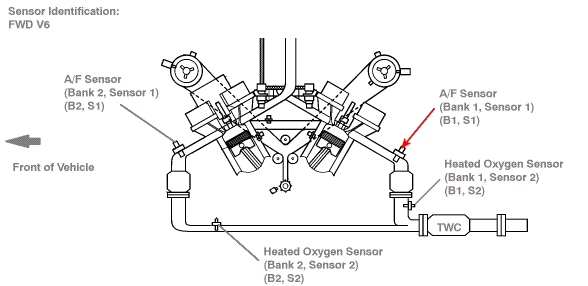
Understanding oxygen sensor output voltage, especially Bank 1 Sensor 1 (B1-S1), is crucial for both car owners and mechanics to ensure optimal engine performance, fuel efficiency, and emissions control. This sensor plays a critical role in the feedback loop that your engine control unit (ECU) uses to adjust the air-fuel mixture. This article focuses on practical maintenance, troubleshooting common issues, and providing real-world examples related to B1-S1 oxygen sensor voltage.
Understanding Oxygen Sensors: A Quick Overview
Before diving into troubleshooting, let's quickly recap the basics. Oxygen sensors measure the amount of oxygen in the exhaust gas. This information is relayed to the ECU, which then adjusts the fuel injector pulse width to achieve the ideal air-fuel ratio (typically 14.7:1, known as stoichiometry). Bank 1 refers to the side of the engine containing cylinder #1. Sensor 1 is the sensor located before the catalytic converter, often referred to as the upstream sensor.
The voltage output of B1-S1 typically fluctuates between 0.1 and 0.9 volts. A low voltage (near 0.1V) indicates a lean condition (excess oxygen), while a high voltage (near 0.9V) indicates a rich condition (insufficient oxygen). The ECU uses these voltage fluctuations to fine-tune the air-fuel mixture in real time.
Common Symptoms of a Faulty B1-S1 Oxygen Sensor
A failing or malfunctioning B1-S1 oxygen sensor can manifest in several ways. Recognizing these symptoms early can prevent more significant engine problems.
- Check Engine Light (CEL): This is the most obvious symptom. Common OBD-II codes associated with B1-S1 include P0131 (B1-S1 Low Voltage), P0132 (B1-S1 High Voltage), P0130 (B1-S1 Malfunction), and P0171/P0174 (System Too Lean) or P0172/P0175 (System Too Rich).
- Poor Fuel Economy: A faulty sensor can cause the ECU to miscalculate the optimal air-fuel mixture, leading to excessive fuel consumption.
- Rough Idling: The engine might idle erratically, surge, or even stall, especially when cold.
- Hesitation During Acceleration: The engine may hesitate or stumble when you press the accelerator pedal.
- Failed Emissions Test: An improperly functioning oxygen sensor can cause increased levels of pollutants in the exhaust gas, leading to a failed emissions test.
- Black Smoke from Exhaust: Indicates a very rich condition, possibly caused by a sensor stuck at high voltage.
Troubleshooting B1-S1 Oxygen Sensor Voltage Issues
When faced with symptoms related to B1-S1, a systematic approach to troubleshooting is essential. Here's a breakdown of common problems and solutions:
1. Scan for Diagnostic Trouble Codes (DTCs)
The first step is to connect an OBD-II scanner to your vehicle and read any stored DTCs. Record all codes, even if they seem unrelated, as they can provide valuable clues. Clear the codes after recording them, and then drive the vehicle to see if the codes reappear.
2. Inspect the Sensor and Wiring
Visually inspect the B1-S1 oxygen sensor for any signs of damage, such as cracks, corrosion, or loose connections. Pay close attention to the wiring harness and connector. Look for frayed wires, broken insulation, or corroded terminals. Use a multimeter to check for continuity in the wiring and to verify that the sensor is receiving power and ground.
Example: On a 2010 Honda Civic, a common issue is corrosion within the oxygen sensor connector due to its location near the exhaust manifold. Cleaning the connector with electrical contact cleaner and applying dielectric grease can sometimes resolve the problem.
3. Check for Vacuum Leaks
Vacuum leaks can significantly affect the air-fuel mixture and cause false readings from the oxygen sensor. Inspect all vacuum hoses, intake manifold gaskets, and throttle body seals for any signs of leaks. You can use a smoke machine to detect even small leaks. A vacuum leak typically causes a lean condition.
Example: On a 2015 Ford F-150 with the 3.5L EcoBoost engine, a cracked intake manifold is a known issue that can cause vacuum leaks, leading to a lean condition and potentially triggering B1-S1 related DTCs.
4. Test the Oxygen Sensor Voltage
With the engine running and warmed up, use a multimeter to monitor the voltage output of the B1-S1 oxygen sensor. The voltage should fluctuate rapidly between 0.1 and 0.9 volts. A sluggish or stagnant voltage reading indicates a faulty sensor.
Important: Some advanced scanners can display live oxygen sensor data, including voltage and waveform. This is the preferred method for accurately assessing sensor performance.
Example: If you observe a B1-S1 voltage that is consistently stuck at 0.8 volts on a 2012 Toyota Camry, even after the engine is warmed up, it's highly likely the sensor is faulty and needs replacement.
5. Check Fuel Pressure
Incorrect fuel pressure can also affect the air-fuel mixture and impact oxygen sensor readings. A low fuel pressure can cause a lean condition, while a high fuel pressure can cause a rich condition. Use a fuel pressure gauge to verify that the fuel pressure is within the manufacturer's specifications.
6. Evaluate Mass Air Flow (MAF) Sensor
The MAF sensor measures the amount of air entering the engine. A faulty MAF sensor can provide inaccurate readings to the ECU, leading to incorrect air-fuel mixture calculations. Clean the MAF sensor with a dedicated MAF sensor cleaner. If cleaning doesn't resolve the issue, consider replacing the sensor.
Example: On a 2018 Chevrolet Silverado, a dirty or malfunctioning MAF sensor can cause a lean condition, potentially triggering P0171 and P0131 codes.
7. Catalytic Converter Efficiency
While B1-S1 is before the catalytic converter, a severely degraded catalytic converter can indirectly impact its readings. If the downstream oxygen sensor (B1-S2) is mirroring the upstream sensor (B1-S1) readings, it indicates the catalytic converter is not functioning properly. This is often accompanied by P0420 code.
Real-World Problem-Solution Examples
Here are a few real-world examples of B1-S1 problems and their solutions:
- Problem: 2014 Jeep Grand Cherokee displaying P0131 code (B1-S1 Low Voltage). The engine was running lean, and fuel economy was poor. Solution: Visual inspection revealed a cracked vacuum hose near the intake manifold. Replacing the hose resolved the vacuum leak, restoring proper air-fuel mixture and eliminating the P0131 code.
- Problem: 2016 Nissan Altima exhibiting rough idling and hesitation during acceleration, along with a P0132 code (B1-S1 High Voltage). Solution: After confirming proper fuel pressure and no vacuum leaks, the B1-S1 oxygen sensor was tested and found to be consistently outputting high voltage. Replacing the faulty oxygen sensor resolved the issue.
- Problem: 2019 Hyundai Elantra with a persistent P0171 code (System Too Lean) and poor fuel economy. Solution: The MAF sensor was cleaned, but the problem persisted. A smoke test revealed a small leak at the intake manifold gasket. Replacing the gasket eliminated the vacuum leak and resolved the lean condition.
Maintenance Tips for Oxygen Sensors
Preventative maintenance can significantly extend the life of your oxygen sensors and prevent costly repairs.
- Use High-Quality Fuel: Avoid using low-quality fuel that may contain contaminants that can damage the oxygen sensors.
- Regular Oil Changes: Maintain a regular oil change schedule to prevent oil from contaminating the oxygen sensors.
- Address Engine Problems Promptly: Fix any engine problems, such as vacuum leaks or misfires, promptly to prevent damage to the oxygen sensors.
- Avoid Using Silicone-Based Sealants: When working on exhaust systems, avoid using silicone-based sealants, as they can damage the oxygen sensors.
- Properly Torque the Sensors: When installing a new oxygen sensor, ensure it is torqued to the manufacturer's specifications to prevent leaks.
Conclusion
Oxygen sensor B1-S1 is a vital component of your vehicle's engine management system. By understanding its function, recognizing common symptoms of failure, and following a systematic troubleshooting approach, both car owners and mechanics can effectively diagnose and resolve oxygen sensor-related issues. Regular maintenance and prompt attention to engine problems will help keep your car running smoothly, efficiently, and environmentally friendly. Remember to always consult your vehicle's repair manual for specific procedures and torque specifications.
Keeping your car in top condition involves proactive maintenance, regular inspections, and addressing small issues before they escalate into major problems. By staying informed and taking care of your vehicle, you can ensure its longevity and reliability for years to come.