
Points Where To Put Jack Stands Under Car
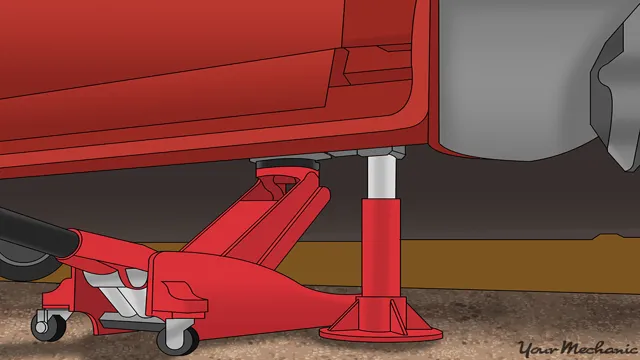
Working on your car at home can be incredibly rewarding, saving you money and giving you a deeper understanding of your vehicle. But safety is paramount. One of the most critical aspects of DIY car maintenance is properly securing your vehicle with jack stands after lifting it with a jack. Knowing the correct jacking points and, more importantly, the support points for jack stands is crucial to prevent serious injury or damage to your car.
Understanding the Difference: Jacking Points vs. Support Points
It's a common mistake to assume that the points where you place your jack are also suitable for supporting the vehicle with jack stands. While sometimes they overlap, they are often distinct. Jacking points are reinforced areas designed to withstand the concentrated force of a jack, typically for lifting the car high enough to change a tire or access the undercarriage. Support points, on the other hand, are structural parts of the vehicle's frame or unibody engineered to bear the car's weight safely for extended periods.
Imagine trying to lift a bookshelf. You might apply force near the bottom edge to leverage it up (jacking point). But you wouldn't want to rest the entire bookshelf on that thin edge for hours; you'd want to distribute the weight along a sturdy side panel (support point).
Identifying Safe Support Points
The best resource for locating safe support points is your car's owner's manual. It will typically have diagrams illustrating the designated jacking points and, crucially, the recommended areas for placing jack stands. However, manuals can sometimes be vague, or you might not have access to one. Here are some general guidelines and common locations:
Frame Rails
On vehicles with a frame (typically older cars, trucks, and SUVs), the frame rails are a primary choice for jack stand placement. These are sturdy, longitudinal members running along the length of the car's underbody. They are usually box-shaped or C-shaped steel components. Look for areas where the frame rail is straight and free from rust or damage. For example, on an older Chevrolet Silverado truck, the frame rails are quite prominent and provide ample space for positioning jack stands.
Caution: Always inspect frame rails for rust or damage before using them as support points. Rust can significantly weaken the metal, making it unsafe to bear the car's weight.
Unibody Pinch Welds
Many modern cars, like a Honda Civic or a Toyota Corolla, use a unibody construction. In this design, the body and frame are integrated into a single structure. Unibody vehicles often have reinforced pinch welds along the rocker panels (the area just below the doors) specifically designed to be used as jacking and support points. These pinch welds are typically marked with a small notch or arrow.
To use pinch welds effectively with jack stands, you'll often need a pinch weld adapter. This is a rubber or plastic pad that fits onto the jack stand and has a groove that conforms to the shape of the pinch weld. This prevents damage to the pinch weld and ensures a secure and stable contact point. Without an adapter, the metal of the jack stand can bend or crush the pinch weld.
Subframe Components
Both framed and unibody vehicles have subframes, which are separate structural components bolted to the main frame or unibody. These subframes typically support the engine, transmission, and suspension. Certain points on the subframe, particularly where suspension components are mounted, can be used as support points. However, it's vital to identify these points carefully.
For instance, on a front-wheel-drive Volkswagen Golf, you might find suitable support points on the front subframe where the lower control arms are attached. These areas are designed to handle significant loads and are generally robust. But avoid using any part of the subframe that appears thin, flimsy, or is connected with rubber bushings, as these are not designed to support the vehicle's weight.
Suspension Mounting Points (Use with Caution)
While not always ideal, some suspension mounting points can be used as support points if properly identified and assessed. Look for areas where the suspension components (like control arms or struts) attach directly to the frame or unibody. These points are usually reinforced and designed to withstand considerable stress. However, exercise extreme caution when using suspension mounting points, as they can be difficult to access and may not provide a perfectly stable platform.
For example, the lower control arm mounting points on a rear-wheel-drive BMW 3 Series might be used, but ensure the jack stand is positioned securely and evenly under the mounting point to avoid any twisting or slippage.
The Importance of a Level Surface and Proper Technique
Even with correctly identified support points, a level surface is essential for safe jacking and supporting. Uneven ground can cause the jack stands to shift or tip over, leading to catastrophic failure. Always work on a flat, solid surface like a concrete driveway or garage floor. If the surface is slightly uneven, use shims or wooden blocks to level the jack stands.
Here's a step-by-step process for safely lifting and supporting your car:
- Consult your owner's manual to identify the correct jacking points and support points.
- Park your car on a level surface and engage the parking brake. Chock the wheels that will remain on the ground.
- Use a jack to lift the vehicle at the designated jacking point. Lift the car high enough to place the jack stands at the support points.
- Carefully position the jack stands under the identified support points. Ensure they are securely seated and properly adjusted to the correct height.
- Slowly lower the jack until the vehicle's weight is fully supported by the jack stands. Leave the jack in place as a secondary safety measure.
- Give the car a gentle shove to ensure it is stable and secure on the jack stands. If there is any movement or instability, re-evaluate your support points and adjust the jack stands as needed.
Practical Takeaways
- Always prioritize safety. Working under a car supported only by a jack is extremely dangerous. Always use jack stands.
- Consult your owner's manual for specific jacking points and support point locations.
- Use the right tools. A pinch weld adapter is essential for unibody vehicles.
- Inspect support points for rust or damage before using them.
- Work on a level surface.
- Lower the vehicle slowly onto the jack stands.
- Leave the jack in place as a backup.
- Give the car a gentle shove to test stability.
By following these guidelines and using common sense, you can safely and effectively use jack stands to work on your car at home. Remember, when in doubt, consult a professional mechanic. Your safety is paramount.