
What Does Oil And Coolant Mixed Look Like
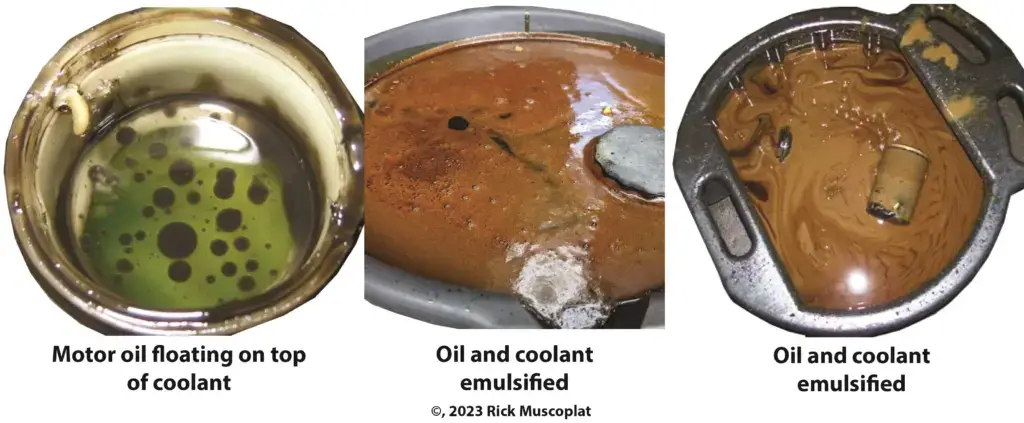
The dread. The sinking feeling. The suspicion that something is terribly wrong under the hood. We’ve all been there. Maybe it's an unusual smell, a performance dip, or a dashboard warning light. But what if you pop the hood and find something truly unsettling – a milky, brownish sludge where your coolant should be, or an oily sheen swirling in your radiator reservoir? The telltale sign: oil and coolant mixed. But beyond identifying the immediate problem, understanding the future implications of this issue is crucial in an era of rapidly evolving automotive technology.
The Grim Diagnosis (and its Future Irrelevance?)
For the internal combustion engine (ICE), oil and coolant mixing typically points to a catastrophic failure – a blown head gasket, a cracked cylinder head, or a damaged engine block. Oil, pressurized to lubricate vital engine components, finds its way into the coolant passages, or vice versa. This mixture drastically reduces the effectiveness of both fluids, leading to overheating, accelerated wear, and potentially irreparable engine damage. Repair costs can be significant, often exceeding the value of older vehicles. The traditional method involves disassembling the engine, identifying the source of the leak, and replacing damaged parts. Labor intensive and expensive.
But the horizon is shifting. As electric vehicles (EVs) and advanced hybrid systems gain prevalence, the very nature of this problem is poised to become largely obsolete. While EVs don't have oil in the traditional sense (only lubrication for gearboxes and motors), and use specialized coolants for battery thermal management, the catastrophic mixing of fluids in an EV is a different beast. Instead of the ICE problem, we face potential battery thermal runaway situations, which are far more dangerous and require entirely new diagnostic and mitigation strategies. Future EVs will rely heavily on sophisticated sensors and AI-powered monitoring systems to detect anomalies in battery temperature and coolant circulation before a catastrophic failure occurs. Expect "digital twins" of battery packs, constantly simulating performance and predicting potential issues, to become commonplace.
Hybrid Systems: A Transitional Challenge
Hybrid vehicles, in the present, represent a unique challenge. They inherit the complexities of both ICE and electric drivetrains. So, yes, you can still experience the dreaded oil and coolant mixing scenario in the ICE component of a hybrid. Furthermore, hybrid systems introduce additional coolant loops for battery and power electronics cooling. While less likely, contamination between these loops could lead to reduced efficiency and potential component failure. The diagnostic process in hybrids becomes more intricate, requiring specialized tools and expertise. Technicians need to be proficient in both ICE and EV diagnostics to accurately pinpoint the source of the problem.
Smart Automotive Solutions and Predictive Maintenance
The future of automotive maintenance is undoubtedly connected. Smart automotive solutions, leveraging onboard diagnostics (OBD) and cloud connectivity, offer the potential for predictive maintenance. Imagine sensors continuously monitoring the properties of your coolant and oil – viscosity, pH levels, and the presence of contaminants. Machine learning algorithms analyze this data in real-time, identifying subtle deviations from the norm that could indicate an impending problem. You receive an alert on your smartphone, suggesting a preventative service appointment before a major failure occurs. This isn't science fiction; it's the direction the industry is headed.
Furthermore, advanced materials science is playing a crucial role. New gasket materials, engine block designs, and coolant formulations are engineered to be more robust and resistant to degradation, reducing the likelihood of leaks and failures. Self-healing materials, though still in their early stages of development, hold the potential to automatically repair minor cracks and leaks, extending the lifespan of critical engine components.
The Challenges Ahead
While the future looks promising, several challenges remain. The cost of implementing advanced sensor technology and AI-powered predictive maintenance systems needs to be reduced to make it accessible to all consumers. Data privacy and security concerns surrounding connected car technology must be addressed. And, perhaps most importantly, the automotive workforce needs to be retrained and upskilled to handle the complexities of EV and hybrid systems. The transition from traditional ICE mechanics to EV technicians requires a significant investment in education and training. Failure to address these challenges could hinder the widespread adoption of these technologies and delay the realization of their full potential.
A Visionary Note
Looking beyond the immediate problem of oil and coolant mixing, the future of mobility is about more than just preventing engine failures. It's about creating a safer, more sustainable, and more convenient transportation ecosystem. Autonomous vehicles, powered by renewable energy and connected to smart city infrastructure, will revolutionize the way we move. The traditional concept of car ownership may become obsolete, replaced by on-demand mobility services. The focus will shift from individual vehicle maintenance to fleet management and optimization. In this future, the dreaded sight of oil and coolant mixing will be a distant memory, a relic of a bygone era. The true challenge lies in building a future where technology serves humanity, creating a world where mobility is accessible, affordable, and environmentally responsible for all. A future where data helps us predict and preempt any type of breakdown that can be avoided, not just for our vehicles, but for the entire network of interconnected mobility, a symphony of movement that is reliable, efficient, and sustainable.