
Where Is The Canister Purge Valve Located
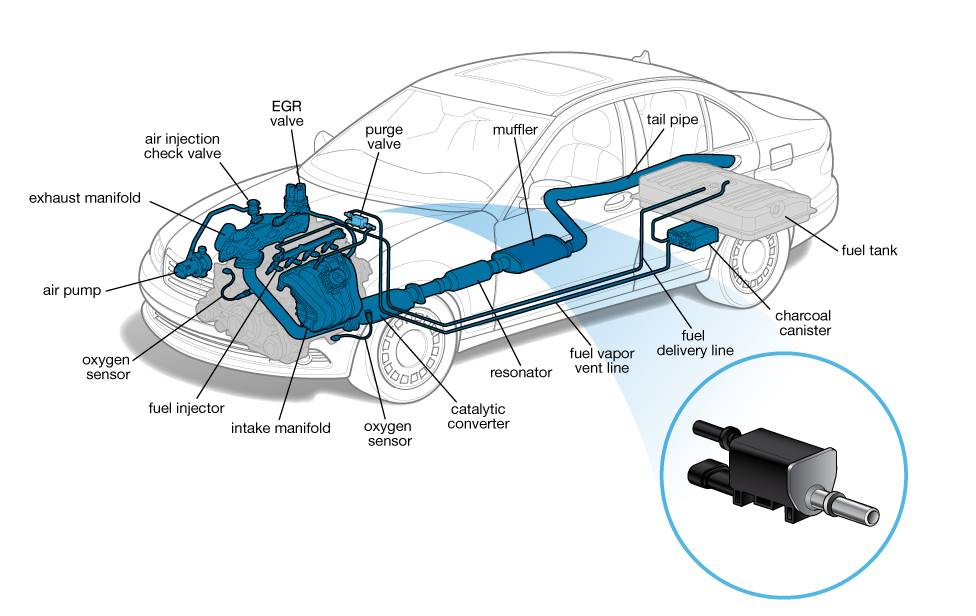
The canister purge valve. Sounds like something straight out of a sci-fi movie, right? But in reality, it's a crucial, albeit often overlooked, component in your car's emission control system. Its job is simple: to regulate the flow of fuel vapors from the charcoal canister to the engine, preventing them from escaping into the atmosphere. But where exactly *is* this little green warrior hiding?
The Great Purge Valve Hide-and-Seek
Finding the purge valve is like playing automotive hide-and-seek. Its location varies significantly depending on the make, model, and engine type of your vehicle. There's no universal "X marks the spot" on the engine bay map. However, some common locations are more likely than others.
Generally, you'll find it somewhere along the intake manifold, close to the throttle body or intake plenum. The purge valve needs to be positioned in a location where it can easily introduce the fuel vapors into the intake stream. It will also be connected to vacuum lines and an electrical connector. Follow those hoses and wires, and you're likely getting warmer!
Let's dive into some specific examples to illustrate the variation:
Location Examples by Vehicle Type
| Vehicle Type | Engine Type | Typical Location | Notes |
|---|---|---|---|
| Late Model Honda Civic | 1.5L Turbocharged | Front of the engine, near the intake manifold | Easily accessible, often with a bright green connector. |
| Ford F-150 | 3.5L EcoBoost | Passenger side of the engine, near the intake plenum | May be partially obscured by other components. |
| BMW 3 Series (E46) | 2.5L Inline-6 | Under the intake manifold, towards the rear of the engine | Can be challenging to access without removing some parts. |
| Chevrolet Corvette (C7) | 6.2L LT1 V8 | On top of the intake manifold, near the throttle body | Relatively easy to access due to engine layout. |
Pros and Cons of Different Locations
The placement of the purge valve isn't just about aesthetics (though some manufacturers seem to disagree!). Different locations offer varying advantages and disadvantages:
- Easier Access (e.g., Honda Civic):
- Pros: Simpler to diagnose, replace, and maintain. Saves time and money.
- Cons: Potentially more exposed to heat and contaminants, potentially shortening lifespan.
- Difficult Access (e.g., BMW E46):
- Pros: More protected from the elements, potentially increasing lifespan.
- Cons: Requires more labor to diagnose and repair, increasing costs. Frustration levels skyrocket.
- Near Throttle Body (e.g., Corvette C7):
- Pros: Efficient delivery of fuel vapors, potentially improving engine performance and emissions.
- Cons: More susceptible to carbon buildup from the throttle body, potentially requiring more frequent cleaning.
Real-World Driving Impressions: Does Location Matter?
Does the purge valve's location *actually* affect your driving experience? In most cases, the answer is no, until it fails. A faulty purge valve, regardless of its location, can lead to a rough idle, poor fuel economy, a check engine light (usually accompanied by a P0441 or similar code), and even difficulty starting. However, the accessibility of the valve *certainly* impacts the cost and time required for repair.
Imagine you're on a road trip in your trusty Civic, and the purge valve decides to give up the ghost. A quick stop at a local mechanic, and you're back on the road in an hour. Now picture the same scenario in your classic E46. Suddenly, that road trip involves a tow truck, a hefty labor bill, and a serious delay. Location, location, location – it matters when things go wrong!
Technology's Influence
Modern engine designs, particularly those with direct injection, are increasingly incorporating more sophisticated vapor recovery systems. This often leads to the purge valve being integrated more closely with other components, such as the fuel rail or intake manifold. While this may improve efficiency and reduce emissions, it can also make diagnosis and repair more complex.
Electric vehicles, of course, don't have fuel tanks and therefore don't have a canister purge valve, however, some hybrid vehicles do.
Final Thoughts (and a little controversy)
So, the next time you're under the hood, take a moment to appreciate the humble canister purge valve and its crucial role in keeping our air clean (and our cars running smoothly). And the next time you need to find it, well, good luck! Hopefully, this guide has given you a head start.
But here's a thought to ponder: Is the location of the canister purge valve a deliberate engineering choice, or simply a case of squeezing it in wherever there's space? Let the debate begin!