
2019 Nissan Frontier Towing Capacity Chart
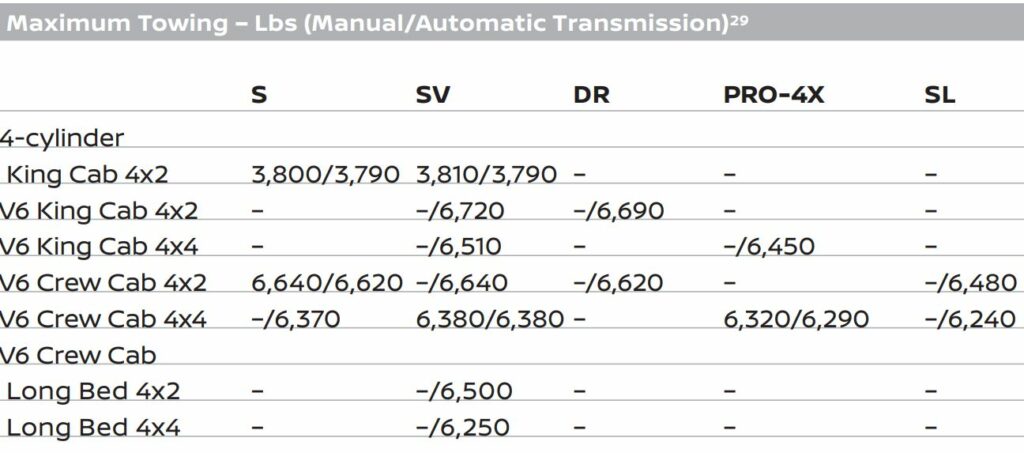
Understanding the towing capacity of your 2019 Nissan Frontier is crucial for safe and effective hauling. Exceeding these limits can lead to serious mechanical issues, compromised handling, and even dangerous accidents. This article provides a comprehensive overview of the 2019 Frontier's towing capabilities, delving into the factors that influence it and offering practical guidance for responsible towing.
Decoding the 2019 Frontier Towing Chart: A Model-by-Model Breakdown
Nissan doesn't publish a single, unified "towing chart" in the traditional sense. Instead, towing capacity is dictated by the specific configuration of your truck. This means paying close attention to the engine, drivetrain (2WD or 4WD), cab style (King Cab or Crew Cab), and bed length. To find the exact towing capacity for your Frontier, consult the sticker located on the driver's side doorjamb. This sticker provides the Gross Vehicle Weight Rating (GVWR) and Gross Axle Weight Rating (GAWR) information, which are essential for calculating safe towing limits.
Here's a general guideline based on typical 2019 Frontier configurations. Keep in mind that these are estimates and your specific vehicle's rating will supersede this:
- 2.5L I4 Engine (2WD King Cab): Generally, models with the 2.5L four-cylinder engine have a lower towing capacity, typically around 3,500 lbs. This engine is primarily for lighter duty tasks.
- 4.0L V6 Engine (2WD King Cab): Models equipped with the 4.0L V6 engine see a significant boost. Expect towing capacities in the range of 6,290 to 6,710 lbs, depending on specific options.
- 4.0L V6 Engine (4WD King Cab): The addition of four-wheel drive often slightly reduces towing capacity due to the increased weight of the 4WD system. Expect a range of approximately 6,130 to 6,510 lbs.
- 4.0L V6 Engine (2WD Crew Cab): The Crew Cab configuration, with its longer wheelbase and additional weight, impacts towing. 2WD Crew Cab models typically range from 6,250 to 6,640 lbs.
- 4.0L V6 Engine (4WD Crew Cab): The 4WD Crew Cab configuration usually has the lowest towing capacity among V6 Frontiers. Look for ratings between 6,090 and 6,370 lbs.
Important Note: These figures assume the vehicle is properly equipped with a tow package, which often includes features like a Class IV hitch receiver, wiring harness, and possibly upgraded cooling components. We'll discuss the tow package in more detail later.
Key Terminology: Deciphering the Towing Acronyms
Before you hitch up your trailer, it's crucial to understand the following terms:
- GVWR (Gross Vehicle Weight Rating): This is the maximum permissible weight of the vehicle, including the vehicle itself, passengers, cargo, and tongue weight of the trailer. It's a fixed value determined by the manufacturer.
- GAWR (Gross Axle Weight Rating): This is the maximum weight that each axle (front and rear) can safely carry. Like GVWR, it's a fixed value.
- Curb Weight: This is the weight of the vehicle as it sits, with all standard equipment, fluids at their normal levels, and a full tank of fuel. It does not include passengers or cargo.
- Payload Capacity: This is the maximum weight of passengers and cargo that the vehicle can carry in addition to its curb weight. It's calculated as: GVWR - Curb Weight.
- Towing Capacity: This is the maximum weight of a trailer that the vehicle can safely tow. It's often provided by the manufacturer, but can be influenced by several factors.
- Tongue Weight: This is the amount of weight the trailer exerts on the trailer hitch. It's crucial that tongue weight is within the recommended range (typically 10-15% of the trailer's gross weight) to prevent sway and maintain stability.
- GCWR (Gross Combined Weight Rating): This is the maximum permissible weight of the vehicle and the fully loaded trailer combined. Exceeding the GCWR is extremely dangerous.
The V6 Engine: Powering the Frontier's Towing Prowess
The 4.0L V6 engine, a staple in many 2019 Frontiers, is the primary workhorse for towing. This engine delivers a robust blend of horsepower and torque, both of which are essential for pulling heavy loads. Horsepower determines the vehicle's ability to maintain speed, while torque provides the pulling power needed to get the trailer moving. The 4.0L V6 typically produces around 261 horsepower and 281 lb-ft of torque, making it a capable engine for light to medium-duty towing.
However, it's important to remember that even with a powerful engine, proper maintenance is critical. Regular oil changes, coolant flushes, and spark plug replacements will ensure the engine operates at peak efficiency and provides the power needed for safe towing. Consider using a higher-quality synthetic oil to provide enhanced protection under the increased stress of towing.
The Tow Package: Unlocking Maximum Towing Potential
The factory tow package (if equipped) is vital for achieving the Frontier's maximum towing capacity. It typically includes the following components:
- Class IV Hitch Receiver: A stronger hitch receiver designed to handle higher tongue weights and trailer weights.
- 7-Pin Wiring Harness: This provides connections for trailer lights (brake lights, turn signals, running lights) and often includes a circuit for electric trailer brakes. Electric brakes are essential for trailers over a certain weight, usually around 3,000 lbs.
- Transmission Cooler: Towing puts extra strain on the transmission, generating significant heat. A transmission cooler helps dissipate this heat, preventing damage and extending the transmission's lifespan. If your Frontier doesn't have a factory cooler, consider adding an aftermarket one.
- Heavy-Duty Radiator: Similar to the transmission cooler, a heavy-duty radiator helps the engine maintain a safe operating temperature under heavy loads.
If your Frontier is not equipped with a tow package, it's highly recommended to have one professionally installed if you plan to tow regularly. While you might be able to tow a small trailer without it, you'll be significantly limiting your towing capacity and putting undue stress on the vehicle's components. An aftermarket transmission cooler is a worthwhile investment, even if you already have the factory tow package, especially if you live in a hot climate or frequently tow heavy loads.
Towing Best Practices: Ensuring Safety and Longevity
Beyond knowing your Frontier's towing capacity, practicing safe towing techniques is paramount.
- Proper Trailer Loading: Distribute the weight evenly in the trailer, with approximately 60% of the load forward of the axle. This helps prevent trailer sway. Secure the load properly to prevent shifting during transport.
- Regular Inspections: Before each trip, inspect the trailer tires, lights, brakes, and hitch connections. Check the tire pressure and ensure the lug nuts are properly torqued.
- Safe Driving Habits: Increase your following distance, avoid sudden braking or sharp turns, and drive at a moderate speed. Remember that towing a trailer significantly increases your stopping distance.
- Use Trailer Brakes: If your trailer is equipped with electric brakes, ensure they are properly adjusted and functioning correctly. This will significantly improve your stopping power. A trailer brake controller is required to operate electric trailer brakes.
- Consider a Weight Distribution Hitch: For heavier trailers, a weight distribution hitch can help distribute the tongue weight more evenly across the vehicle's axles, improving stability and handling.
- Monitor Temperatures: Use a scan tool or aftermarket gauges to monitor engine coolant temperature and transmission fluid temperature, especially during long trips or when towing uphill. If temperatures get too high, pull over and let the vehicle cool down.
Modifications and Their Impact on Towing
Modifications can impact your Frontier's towing capacity, sometimes positively, but often negatively. Here's what to consider:
- Lift Kits: While a lift kit might improve off-road capability, it can raise the vehicle's center of gravity and negatively affect handling, especially when towing. Choose lift kits designed for towing and consider installing a sway bar to improve stability.
- Larger Tires: Larger tires can alter the vehicle's gear ratio, potentially reducing towing capacity and fuel economy. Ensure the tires are rated for the load you'll be carrying and towing. Recalibrating the speedometer is also essential for accurate speed readings and shift points.
- Aftermarket Bumpers: Heavy-duty bumpers can add significant weight to the vehicle, reducing payload capacity and potentially impacting towing capacity. Choose lightweight options if possible.
- Engine Upgrades: While engine upgrades might increase horsepower and torque, it's crucial to ensure the rest of the drivetrain (transmission, axles) can handle the increased power, especially when towing. Consult with a reputable performance shop to ensure the upgrades are suitable for towing applications.
Crucially, any modification that increases the vehicle's weight or alters its handling characteristics can affect its towing capacity and safety. Always consult with a qualified mechanic or towing specialist before making any modifications if you plan to tow with your Frontier.
Conclusion
Understanding the 2019 Nissan Frontier's towing capacity is a blend of knowing your specific model's limitations, understanding the relevant terminology, and practicing safe towing techniques. Always err on the side of caution and never exceed the manufacturer's recommended limits. By following these guidelines, you can safely and effectively tow with your 2019 Nissan Frontier for years to come.