
Firing Order 2006 Nissan Pathfinder
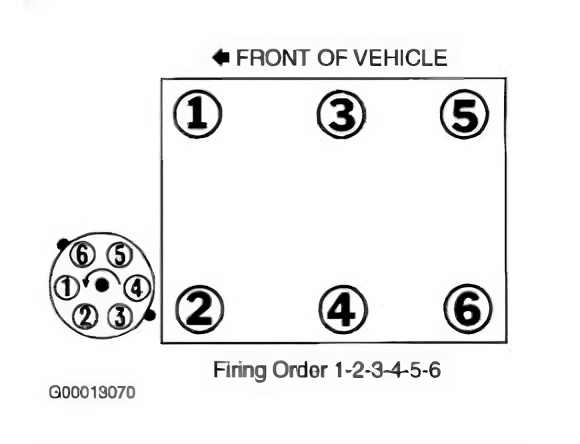
Understanding the firing order of an internal combustion engine is fundamental to grasping its operational principles. While seemingly a simple sequence, the firing order dictates the timing of combustion events within the cylinders, influencing engine balance, vibration, and overall performance. Let's delve into the intricacies of the firing order for the 2006 Nissan Pathfinder, equipped with the VQ40DE engine, a powerplant known for its reliability and smooth power delivery.
The VQ40DE: A Foundation
The 2006 Nissan Pathfinder predominantly features the VQ40DE engine, a 4.0-liter (3954 cc) V6 engine. This engine is a member of Nissan's highly regarded VQ engine family, celebrated for their lightweight design, robust construction, and excellent power-to-weight ratio. Knowing the engine configuration – a V6 – is crucial because it directly impacts the firing order.
In a V6 engine, the cylinders are arranged in two banks of three cylinders each, set at an angle to each other. This configuration helps to reduce engine length compared to an inline-six, leading to better packaging within the vehicle. However, it also introduces complexities in balancing the engine, which is where the firing order plays a significant role.
Decoding the Firing Order: 1-2-3-4-5-6
The 2006 Nissan Pathfinder's VQ40DE engine boasts a firing order of 1-2-3-4-5-6. This seemingly straightforward sequence requires a deeper interpretation. It doesn't simply mean the cylinders fire sequentially from 1 to 6. Rather, it indicates the order in which the combustion strokes occur within each cylinder.
To understand this, we need to consider the cylinder numbering convention for the VQ40DE. Viewing the engine from the front of the vehicle (where the accessory belts are located), the right bank (closest to the firewall) is typically referred to as Bank 1, and the left bank as Bank 2. Cylinders are numbered as follows:
- Bank 1: Cylinders 1, 3, and 5
- Bank 2: Cylinders 2, 4, and 6
Therefore, the firing order 1-2-3-4-5-6 translates to the following sequence of combustion events:
- Cylinder 1 (Bank 1)
- Cylinder 2 (Bank 2)
- Cylinder 3 (Bank 1)
- Cylinder 4 (Bank 2)
- Cylinder 5 (Bank 1)
- Cylinder 6 (Bank 2)
The Importance of the Firing Order
The specific firing order of 1-2-3-4-5-6 for the VQ40DE is carefully chosen to achieve several critical objectives:
- Engine Balance: The primary goal is to minimize vibrations and ensure smooth engine operation. By alternating firing events between the two cylinder banks, the engine's rotating and reciprocating forces are more effectively balanced. This reduces stress on the engine block, crankshaft, and bearings, leading to increased longevity and reduced noise, vibration, and harshness (NVH).
- Crankshaft Loading: The firing order distributes the power impulses generated by combustion events more evenly across the crankshaft. This prevents excessive torsional stresses and bending moments on the crankshaft, improving its durability and resistance to fatigue.
- Exhaust Gas Scavenging: The firing order can influence the efficiency of exhaust gas removal from the cylinders. A well-chosen firing order can minimize interference between exhaust pulses from adjacent cylinders, leading to improved scavenging and reduced residual gas dilution in the intake charge.
- Intake Manifold Design: The firing order impacts the design of the intake manifold. The manifold's runners and plenum are carefully tuned to optimize airflow to each cylinder based on the firing sequence. This ensures each cylinder receives an adequate and consistent charge of air and fuel.
Consequences of Incorrect Firing Order
Installing spark plug wires in the incorrect order, or any disruption to the correct sequence, can have severe consequences for the engine. The potential outcomes include:
- Engine Misfire: The most immediate symptom is a noticeable engine misfire. This occurs when a cylinder fails to fire at the correct time, leading to a loss of power, rough idling, and increased emissions.
- Reduced Power and Fuel Economy: An incorrect firing order compromises the engine's ability to generate power efficiently. The engine will feel sluggish, and fuel economy will suffer.
- Increased Vibrations: The engine will exhibit significantly increased vibrations, which can be felt throughout the vehicle.
- Potential Engine Damage: In severe cases, an incorrect firing order can lead to engine damage. Backfires, pre-ignition, and detonation can occur, potentially damaging pistons, valves, and connecting rods.
Troubleshooting Firing Order Issues
If you suspect a firing order issue in your 2006 Nissan Pathfinder, several steps can be taken to diagnose and rectify the problem:
- Visual Inspection: Carefully inspect the spark plug wires and ensure they are connected to the correct spark plugs and distributor terminals (or coil packs in a distributorless system). Refer to a wiring diagram for the VQ40DE engine.
- Spark Test: Use a spark tester to verify that each spark plug is receiving a strong spark. A weak or absent spark can indicate a problem with the ignition coil, spark plug wire, or spark plug itself.
- Compression Test: Perform a compression test on each cylinder to check for any signs of engine damage, such as burnt valves or worn piston rings. Low compression in one or more cylinders can exacerbate misfire symptoms.
- OBD-II Scanner: Connect an OBD-II scanner to the vehicle's diagnostic port and check for any trouble codes related to misfires or ignition system problems. Common codes include P0300 (random misfire), P0301 (cylinder 1 misfire), P0302 (cylinder 2 misfire), and so on.
Firing Order and the Ignition System
The firing order is intrinsically linked to the ignition system. In older vehicles with distributors, the distributor cap's terminals were arranged according to the firing order, and the distributor rotor would sequentially direct the spark to each cylinder. Modern engines, including the VQ40DE in later models, often use a distributorless ignition system (DIS), where each cylinder has its own individual ignition coil. The engine control unit (ECU) precisely triggers each coil based on the firing order and other engine parameters.
Understanding Coil-on-Plug Systems
Many VQ40DE engines use a coil-on-plug (COP) ignition system. In this setup, each spark plug has its dedicated ignition coil mounted directly on top of it. This eliminates the need for spark plug wires, reducing resistance and improving spark energy. The ECU precisely controls each coil, ensuring optimal ignition timing and combustion.
Advanced Considerations
While the firing order is fundamental, it's essential to recognize that it's just one factor influencing engine performance. Other aspects, such as valve timing, fuel injection strategy, and engine management system calibration, also play significant roles. Engine tuners may sometimes experiment with minor adjustments to these parameters, but altering the core firing order itself is rarely advisable unless undertaking a radical engine modification.
"The firing order is a cornerstone of engine design, representing a carefully engineered compromise between various performance and durability considerations."
In conclusion, the firing order of 1-2-3-4-5-6 in the 2006 Nissan Pathfinder's VQ40DE engine is more than just a sequence of numbers. It represents a carefully orchestrated system that optimizes engine balance, reduces vibrations, and ensures smooth and reliable operation. A thorough understanding of the firing order is crucial for anyone working on or diagnosing issues with this engine.