
How Much Coolant Does A Nissan Altima Hold
Hey there, Nissan Altima owner! Having coolant issues? Maybe you're topping off the reservoir, dealing with overheating, or just tackling some preventative maintenance. One of the first questions that pops up is: "How much coolant does my Altima actually hold?" That's a great question, and the answer isn't always straightforward. It depends on the specific year and engine of your Altima.
Understanding Your Altima's Cooling System Capacity
Generally, most Nissan Altimas have a coolant capacity ranging from approximately 6.9 quarts (6.5 liters) to 9.5 quarts (9 liters). However, to be absolutely sure, you *need* to check your owner's manual. Seriously, dig it out! The specific coolant capacity for *your* vehicle will be listed there, along with the recommended coolant type. It's the most reliable source of information.
Here’s a breakdown by generation, but remember, this is a general guide. *Always* double-check your manual!
Altima Generations & Coolant Capacity (Approximate)
- 1993-1997 (First Generation): Around 6.9 quarts (6.5 liters).
- 1998-2001 (Second Generation): Also generally around 6.9 quarts (6.5 liters).
- 2002-2006 (Third Generation): This is where things start to vary a bit. The 2.5L engine typically holds around 7.4 quarts (7 liters), while the 3.5L V6 engine holds closer to 9.5 quarts (9 liters).
- 2007-2012 (Fourth Generation): Similar to the third generation, the 2.5L engine is around 7.4 quarts (7 liters), and the 3.5L V6 remains at about 9.5 quarts (9 liters).
- 2013-2018 (Fifth Generation): The 2.5L engine usually requires around 7.4 quarts (7 liters). Coolant capacity for the 3.5L V6 engine holds closer to 9.5 quarts (9 liters).
- 2019-Present (Sixth Generation): The 2.5L engine usually requires around 7.4 quarts (7 liters) and the 2.0L VC-Turbo holds around 8.0 quarts (7.6 liters).
Important Note: These figures are for a complete coolant flush and refill. If you're just topping off the reservoir, you'll only need a small amount.
Why Knowing the Coolant Capacity Matters
Getting the coolant capacity right is crucial for several reasons:
- Optimal Cooling: The correct amount of coolant ensures efficient heat transfer from the engine to the radiator, preventing overheating.
- Freeze Protection: Coolant, when mixed with water in the correct ratio, protects your engine from freezing in cold weather. Too little coolant reduces this protection.
- Corrosion Prevention: Coolant contains additives that inhibit corrosion within the cooling system. An incorrect coolant-to-water ratio can diminish these protective properties.
- Preventing Damage: Overfilling the cooling system can create excessive pressure, potentially damaging hoses, the radiator, or even the water pump.
What Happens if You Overfill or Underfill?
Both overfilling and underfilling the cooling system can cause problems. Underfilling, as mentioned above, leads to insufficient cooling, potential freezing, and increased corrosion. You might notice your temperature gauge climbing, especially during hot weather or when climbing hills.
Overfilling isn't quite as immediately catastrophic, but it's still not good. As the engine heats up, the coolant expands. If there's not enough space in the system, the excess coolant will be forced out through the overflow tube, making a mess. More seriously, excessive pressure could damage weaker components like hoses or the radiator cap. Over time, this can also dilute the coolant concentration reducing its effectiveness.
Coolant Types: Using the Right Stuff
Beyond the quantity, the *type* of coolant is just as important. Nissan vehicles typically require a specific type of coolant, often a long-life, ethylene glycol-based coolant. Using the wrong type can lead to corrosion, damage to seals, and reduced cooling efficiency. Refer to your owner's manual or the label on your coolant reservoir for the exact specification. Many modern vehicles use either a blue or green coolant. Mixing coolant types can sometimes lead to gelling and clogging within the system.
Pre-mixed vs. Concentrate: You'll find coolant sold in both pre-mixed (usually 50/50 coolant and distilled water) and concentrated forms. Pre-mixed is convenient for topping off. If you buy concentrate, you *must* mix it with distilled water in the correct ratio (usually 50/50) before adding it to your system. Do not use tap water! Tap water contains minerals that can cause corrosion and scale buildup.
Checking and Topping Off Coolant
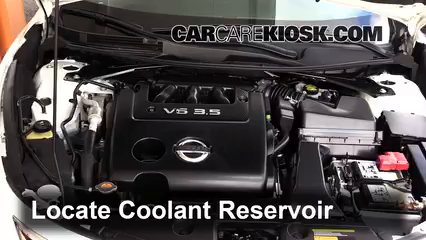
Regularly checking your coolant level is a simple preventative measure. Locate the coolant reservoir (usually a translucent plastic tank near the radiator). Check the coolant level when the engine is cold. The level should be between the "Min" and "Max" or "Low" and "Full" lines. If it's low, top it off with the correct type of coolant mix.
Safety First! Never open the radiator cap when the engine is hot. The system is under pressure, and hot coolant can spray out, causing severe burns. Wait until the engine has cooled down completely before attempting to open the cap.
When to Consider a Coolant Flush
A coolant flush is a more thorough process that involves draining all the old coolant and replacing it with fresh coolant. It's typically recommended every 30,000 to 60,000 miles, or every 2 to 5 years, depending on your driving conditions and the type of coolant used. Consult your owner's manual for the recommended service interval.
Signs that you might need a coolant flush include:
- Discolored or rusty-looking coolant.
- Sludge or debris in the coolant reservoir.
- Overheating issues.
- Coolant leaks.
DIY Coolant Flush vs. Professional Service
Flushing your coolant can be a DIY project if you're comfortable working on cars and have the necessary tools. Here's a general overview of the process:
- Allow the engine to cool completely.
- Locate the radiator drain plug (usually at the bottom of the radiator).
- Place a drain pan under the drain plug.
- Open the drain plug and allow the coolant to drain completely.
- Close the drain plug.
- Fill the cooling system with distilled water.
- Run the engine for a few minutes to circulate the water.
- Allow the engine to cool again.
- Drain the water completely.
- Repeat the flushing process with distilled water until the drained water is clear.
- Close the drain plug securely.
- Mix the appropriate amount of coolant concentrate with distilled water (usually 50/50).
- Fill the cooling system with the coolant mixture to the correct level.
- Bleed the cooling system to remove any air pockets (refer to your vehicle's repair manual for the specific procedure).
- Check the coolant level after a few days and top off as needed.
Tools You'll Need (DIY):
- Drain pan
- Wrench or socket set
- Funnel
- Distilled water
- Coolant concentrate
- Gloves
- Safety glasses
When to Choose a Professional: If you're not comfortable performing this procedure yourself, or if you have any concerns about the cooling system, it's best to take your Altima to a qualified mechanic. They have the expertise and equipment to perform a thorough flush and ensure that the system is properly bled.
Estimated Repair Costs
Here's a rough idea of what you can expect to pay for coolant-related services:
- Coolant Top-Off: $10 - $20 (DIY is even cheaper!)
- Coolant Flush (Professional): $100 - $200 (depending on the shop and the type of coolant used)
- Radiator Replacement: $300 - $800 (parts and labor)
- Water Pump Replacement: $400 - $900 (parts and labor)
- Hose Replacement: $50 - $200 (parts and labor, per hose)
These are just estimates. The actual cost will vary depending on your location, the specific repair needed, and the shop you choose.
Final Thoughts
Knowing your Nissan Altima's coolant capacity and the importance of using the correct coolant type is essential for maintaining its reliability and preventing costly repairs. Remember to consult your owner's manual for the most accurate information, and don't hesitate to seek professional help if you're unsure about any aspect of the cooling system. A well-maintained cooling system will keep your Altima running smoothly for years to come!