
2001 Toyota Camry Exhaust System Diagram
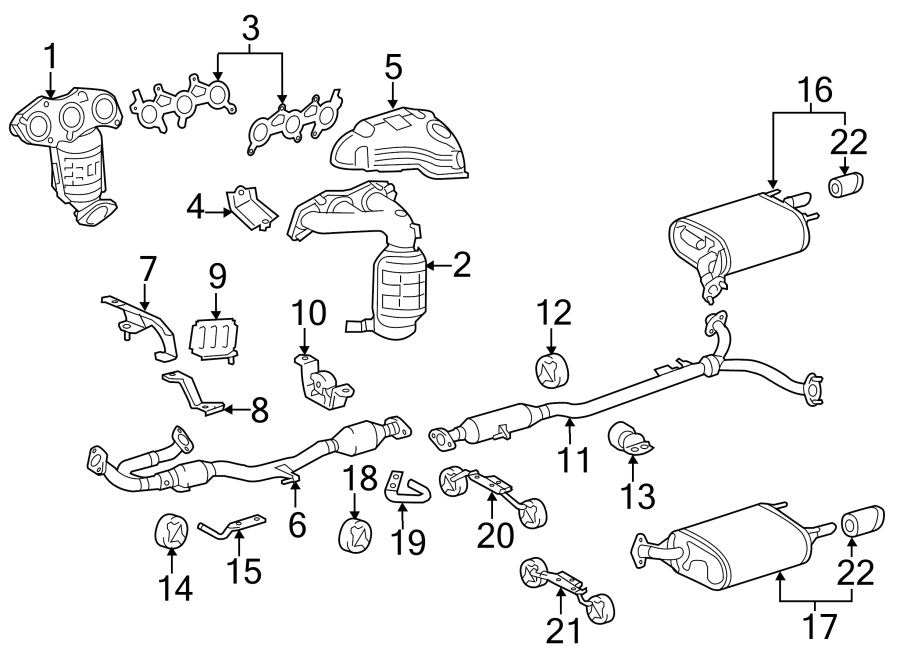
Alright, let's dive into the exhaust system of a 2001 Toyota Camry. This article provides a detailed breakdown of the exhaust system diagram, covering its purpose, key components, how it functions, and some practical tips for troubleshooting. We're assuming you're comfortable wrenching on your car and want to understand the ins and outs of this crucial system.
Purpose of the Exhaust System Diagram
Having a clear diagram of your 2001 Camry's exhaust system is invaluable for several reasons:
- Repair and Maintenance: When diagnosing exhaust issues like leaks, rattles, or catalytic converter problems, the diagram helps you pinpoint the exact location of the faulty component. No more guessing!
- Modification: Thinking of upgrading your exhaust system? The diagram provides a baseline understanding of the factory setup, allowing you to plan your modifications effectively and ensure proper fitment.
- Troubleshooting: Understanding the system's layout helps you trace the flow of exhaust gases, identify potential bottlenecks, and diagnose problems more efficiently.
- Learning: Even if you're not actively working on your exhaust, the diagram offers a great educational resource to learn about your car's mechanics.
Essentially, it's your roadmap to understanding and working on your 2001 Camry's exhaust system.
Key Specs and Main Parts
Before we examine the diagram, let's review the main components of the 2001 Camry's exhaust system:
- Exhaust Manifold: Bolted directly to the engine cylinder head, the manifold collects exhaust gases from each cylinder. It's a critical component, as cracks or leaks here can significantly impact engine performance.
- Catalytic Converter: A crucial emissions control device. It uses catalysts to convert harmful pollutants (like hydrocarbons, carbon monoxide, and nitrogen oxides) into less harmful substances (carbon dioxide, water, and nitrogen). Its efficiency is monitored by oxygen sensors. A failing converter often triggers a check engine light.
- Oxygen Sensors (O2 Sensors): These sensors monitor the oxygen content in the exhaust stream before and after the catalytic converter. The upstream sensor (before the converter) provides feedback to the engine control unit (ECU) to adjust the air-fuel mixture for optimal combustion. The downstream sensor monitors the converter's efficiency.
- Resonator (if equipped): A small chamber designed to reduce specific frequencies of sound, helping to dampen unwanted noise. Not all 2001 Camrys will have this.
- Muffler: The primary noise reduction device. It uses a series of chambers and baffles to attenuate sound waves before they exit the exhaust system. A rusted or damaged muffler can result in a loud, rumbling exhaust note.
- Pipes and Connectors: These connect all the components together, carrying exhaust gases from the engine to the tailpipe.
- Hangers and Mounts: Rubber or metal hangers support the exhaust system under the car, preventing it from rattling or vibrating against the chassis.
- Gaskets and Flanges: Gaskets seal the connections between exhaust components, preventing leaks. Flanges are the metal interfaces where the gaskets sit.
Key Specs: While a specific diagram will have exact pipe diameters and component dimensions, generally, the 2001 Camry's exhaust system uses pipes between 2" and 2.25" in diameter. Material is typically aluminized steel for corrosion resistance.
Symbols and Diagram Interpretation
Understanding the symbols used in the diagram is key to interpreting it correctly. Here's a breakdown of common symbols:
- Solid Lines: Generally represent exhaust pipes. Thicker lines may indicate larger diameter pipes.
- Dashed Lines: Can indicate heat shields, mounting brackets, or less critical components. Refer to the diagram's legend for specific meanings.
- Arrows: Show the direction of exhaust gas flow.
- Circles/Ovals: Often represent flanges or connection points.
- Rectangles: May depict the catalytic converter, resonator, or muffler.
- Special Symbols: Look for specific icons for oxygen sensors (often resembling a light bulb or a stylized sensor) and other components. Always refer to the legend!
Colors are often used to differentiate components. For instance, some diagrams may use:
- Red: High-temperature areas, like the exhaust manifold and near the catalytic converter.
- Blue: Cooler areas, like the tailpipe.
- Gray: Generic components like pipes and supports.
Always refer to the legend of your specific diagram for the accurate interpretation of symbols and colors. Don't assume!
How It Works
The exhaust system's function is quite straightforward:
- Exhaust gases are produced during the combustion process in the engine cylinders.
- These gases are collected by the exhaust manifold.
- The manifold directs the gases to the catalytic converter, where harmful pollutants are converted into less harmful substances.
- Oxygen sensors monitor the exhaust stream's composition, providing feedback to the ECU.
- The exhaust gases then flow through the resonator (if equipped) and the muffler, which reduce noise levels.
- Finally, the exhaust gases exit the system through the tailpipe.
The entire process is designed to remove waste gases from the engine efficiently while minimizing pollution and noise.
Real-World Use: Basic Troubleshooting
Here are some common exhaust system problems and how the diagram can help:
- Exhaust Leak: A hissing or loud sound coming from under the car. Use the diagram to trace the exhaust system and visually inspect for cracks, holes, or loose connections at flanges. Check gasket conditions.
- Rattling Noise: Often caused by loose heat shields or damaged hangers. Use the diagram to locate these components and ensure they are securely attached.
- Check Engine Light (Catalytic Converter Code): Use an OBD-II scanner to confirm the code relates to the catalytic converter. The diagram helps you locate the converter and oxygen sensors for inspection.
- Reduced Engine Performance: A clogged or restricted exhaust system can significantly impact engine performance. The diagram helps you check for potential obstructions in the pipes or catalytic converter. A common culprit is a collapsed or internally damaged catalytic converter.
Remember to always consult your vehicle's service manual for specific diagnostic procedures and torque specifications.
Safety Considerations
Working on an exhaust system can be dangerous:
- Hot Surfaces: The exhaust system gets extremely hot during and after engine operation. Always allow the system to cool completely before working on it.
- Exhaust Gases: Exhaust gases contain harmful substances like carbon monoxide. Work in a well-ventilated area.
- Lifting the Vehicle: Always use jack stands when working under a raised vehicle. Never rely solely on a jack.
- Rust and Corrosion: Exhaust systems are prone to rust and corrosion. Be prepared to use penetrating oil and potentially heat to loosen stubborn bolts.
- Oxygen Sensors: Be careful when handling oxygen sensors. They are delicate and can be damaged easily. Disconnect the battery before working on any electrical components.
The catalytic converter itself is a potentially hazardous component. While not immediately dangerous when cold, avoid breathing in any dust or debris from a damaged converter. Wear a mask if necessary.
This article provides a general overview of the 2001 Toyota Camry's exhaust system diagram. Remember to always consult your vehicle's specific service manual for detailed instructions and safety precautions. Happy wrenching!