
2003 Toyota Camry Exhaust System Diagram
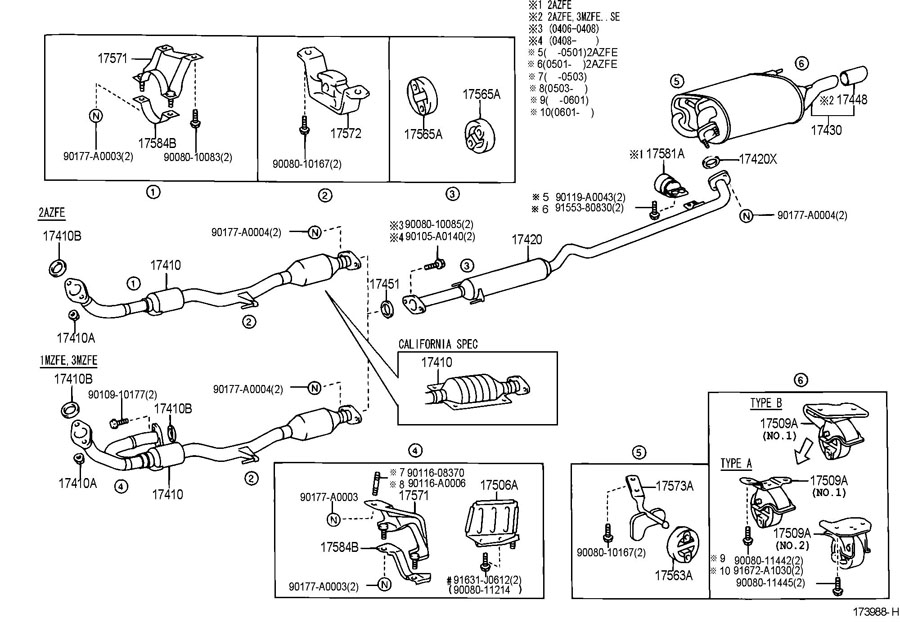
Let's dive into the exhaust system of the 2003 Toyota Camry. Understanding this system is crucial for diagnosing issues, performing routine maintenance, or even planning modifications. This detailed explanation, accompanied by a downloadable diagram (available at the end of this article!), will empower you to tackle exhaust-related tasks with confidence.
Purpose of an Exhaust System Diagram
An exhaust system diagram, like the one we're focusing on for the 2003 Camry, serves several vital purposes:
- Troubleshooting: It's your roadmap when diagnosing exhaust leaks, catalytic converter failures, or muffler problems. By visually tracing the system, you can pinpoint the source of the issue.
- Repair & Replacement: Knowing the precise layout and component locations is essential for replacing worn-out parts or performing repairs.
- Modification: If you're considering upgrading your exhaust system for performance or aesthetics, the diagram provides a foundation for planning and executing your modifications safely and effectively. You'll need to understand clearances, mounting points, and the impact of changes on backpressure and emissions.
- Understanding System Operation: The diagram aids in visualizing how the exhaust system functions, from the exhaust manifold to the tailpipe. This knowledge is essential for understanding engine performance and emissions control.
Key Specs and Main Parts of the 2003 Camry Exhaust System
While specific dimensions can vary slightly depending on the Camry's engine (2.4L I4 or 3.0L V6), the fundamental components and their functions remain consistent. Here's a breakdown:
- Exhaust Manifold: This is the starting point. Bolted directly to the engine cylinder head, it collects exhaust gases from each cylinder. It's typically made of cast iron or, in some performance applications, stainless steel. For the 2003 Camry, the V6 engine will have two manifolds, one for each bank of cylinders.
- Catalytic Converter: A crucial component for emissions control. It uses catalysts (platinum, palladium, and rhodium) to convert harmful gases like hydrocarbons (HC), carbon monoxide (CO), and nitrogen oxides (NOx) into less harmful substances. The 2003 Camry typically has one or two catalytic converters, depending on the engine and emissions configuration. A failing catalytic converter can significantly impact engine performance and fuel economy.
- Resonator (Optional): Some Camry models feature a resonator, a small chamber designed to reduce specific frequencies of sound, helping to control exhaust noise and drone.
- Muffler: The primary noise reduction device. It uses a series of chambers and perforated tubes to attenuate sound waves. A damaged muffler can result in a significantly louder exhaust note.
- Piping: Connects all the components. The diameter and material of the piping influence exhaust flow and backpressure. The 2003 Camry typically uses mild steel piping.
- Oxygen Sensors (O2 Sensors): These sensors are strategically located upstream and downstream of the catalytic converter. They measure the oxygen content in the exhaust gas and provide feedback to the engine control unit (ECU) to optimize fuel-air mixture and monitor catalytic converter efficiency. Faulty O2 sensors can trigger the "check engine" light.
- Flanges and Gaskets: These provide airtight seals between components. Leaks at these points can cause exhaust leaks and affect engine performance.
- Hangers and Mounts: Rubber hangers and metal brackets support the exhaust system and isolate it from the vehicle's chassis, reducing vibration and noise transmission.
Understanding the Symbols in the Exhaust System Diagram
The diagram uses standard automotive symbols to represent various components and connections. Here's what you'll typically find:
- Solid Lines: Represent the physical exhaust pipes connecting the components. The thickness of the line may indicate the pipe diameter.
- Dotted Lines: Often indicate vacuum lines or sensor wiring related to the exhaust system (e.g., O2 sensor wiring).
- Boxes or Rectangles: Typically represent components like the catalytic converter, resonator, and muffler. Internal details of these components are usually simplified.
- Circles or Ellipses: May represent sensors (e.g., O2 sensors) or mounting points.
- Arrows: Indicate the direction of exhaust gas flow.
- Labels: Each component is labeled with its name and sometimes a part number.
- Hardware Symbols: Small symbols may indicate the location of bolts, nuts, and clamps.
How the 2003 Camry Exhaust System Works
The exhaust system's operation is relatively straightforward. Here's a step-by-step explanation:
- Exhaust Gases Exit the Engine: As the engine's exhaust valves open, hot exhaust gases are forced into the exhaust manifold.
- Gases Enter the Catalytic Converter: The gases flow from the manifold into the catalytic converter. Here, the harmful pollutants (HC, CO, and NOx) are converted into less harmful substances through chemical reactions.
- Optional Resonator (If Equipped): If a resonator is present, the exhaust gases pass through it to reduce certain frequencies of noise.
- Gases Enter the Muffler: The exhaust gases then enter the muffler, where they are forced through a series of chambers and perforated tubes, significantly reducing noise levels.
- Exhaust Gases Exit the Tailpipe: Finally, the relatively clean and quiet exhaust gases are expelled from the vehicle through the tailpipe.
- O2 Sensor Feedback: Throughout this process, the O2 sensors monitor the exhaust gas composition and send data to the ECU, allowing it to adjust the fuel-air mixture for optimal combustion and emissions.
Real-World Use and Basic Troubleshooting
Here are some common issues you might encounter and how the diagram can help:
- Exhaust Leak: Symptoms include a hissing or roaring noise, reduced fuel economy, and a possible burning smell. Use the diagram to visually inspect the system for cracks, holes, or loose connections, especially at flanges and welds. Often you'll notice black soot around a leak.
- Catalytic Converter Failure: Symptoms include reduced engine performance, a "check engine" light (typically code P0420 or P0430), and a sulfur smell. The diagram helps you locate the catalytic converter and visually inspect it for damage or excessive heat discoloration.
- Muffler Damage: Symptoms include a loud exhaust noise, rattling sounds, and visible rust or holes. The diagram helps you locate the muffler and assess the extent of the damage.
- O2 Sensor Problems: A "check engine" light and poor fuel economy are common symptoms. The diagram shows the location of the O2 sensors, making it easier to inspect their wiring and connections.
Safety Precautions
Working on the exhaust system involves some inherent risks. Always take these precautions:
- Hot Exhaust: The exhaust system can be extremely hot, even hours after the engine has been turned off. Allow the system to cool completely before working on it.
- Jack Stands: Never work under a vehicle supported only by a jack. Use sturdy jack stands to support the vehicle safely.
- Eye Protection: Wear safety glasses to protect your eyes from debris and rust.
- Gloves: Wear gloves to protect your hands from sharp edges and chemicals.
- Welding (If Applicable): If welding is required, follow proper welding safety procedures, including wearing a welding helmet and gloves. Be aware of flammable materials near the welding area.
- Carbon Monoxide: Never run the engine in an enclosed space, as this can lead to carbon monoxide poisoning.
We have the 2003 Toyota Camry Exhaust System Diagram available for download. This detailed diagram will be an invaluable asset when working on your exhaust system. Click here to download the diagram.