
2005 Cadillac Escalade Fuse Box Diagram
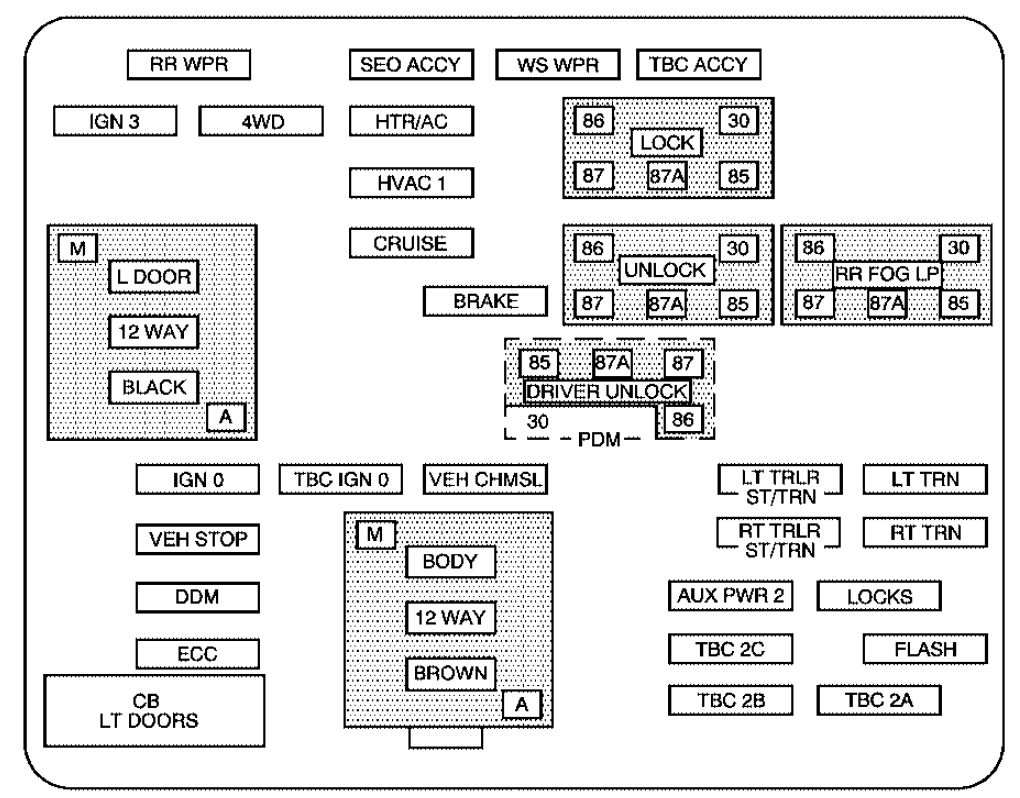
Alright, let's dive into the fuse box diagram for your 2005 Cadillac Escalade. Whether you're tackling a pesky electrical issue, adding some aftermarket accessories, or just trying to better understand your vehicle's electrical system, knowing your way around the fuse box is crucial. This article will break down the diagram, explain what everything means, and give you the confidence to troubleshoot basic electrical problems yourself.
Why Bother with the Fuse Box Diagram?
The fuse box diagram is your roadmap to your Escalade's electrical circuits. It tells you exactly which fuse protects which component. Without it, you're essentially working blind. Here’s why it's so important:
- Troubleshooting Electrical Issues: If your radio suddenly stops working, your power windows give up the ghost, or your headlights are on the fritz, the fuse box is the first place to look. The diagram allows you to quickly identify the fuse associated with the problematic circuit and check if it's blown.
- Adding Aftermarket Accessories: Planning to install a new amplifier, a set of driving lights, or a fancy alarm system? You'll need to tap into the vehicle's electrical system. The diagram helps you find suitable circuits and choose appropriate fuse ratings to protect your new gear and the Escalade's wiring.
- Understanding Your Vehicle: Even if everything is working perfectly, studying the fuse box diagram gives you a deeper understanding of how your Escalade's various systems are powered and protected. This can be invaluable for preventative maintenance and future repairs.
Key Specs and Main Parts of the 2005 Escalade Fuse System
The 2005 Cadillac Escalade typically has two main fuse boxes:
- Underhood Fuse Box: Located in the engine compartment, this box houses fuses and relays for high-current systems such as the starter motor, alternator, headlights, cooling fan, and other engine-related components.
- Instrument Panel Fuse Box: Located inside the cabin, often under the dashboard on the driver's side (accessed by removing a panel), this box protects circuits for interior accessories such as the radio, power windows, power locks, and instrument panel.
The 2005 Escalade utilizes primarily ATO/ATC blade-type fuses. These are the most common type of automotive fuse, characterized by their flat, blade-like terminals and color-coded bodies indicating their amperage rating. Expect fuse ratings ranging from 5 amps to 40 amps, depending on the circuit.
Additionally, you'll find relays in both fuse boxes. A relay is an electrically operated switch that allows a low-current circuit to control a high-current circuit. They're used to protect sensitive switches from high current loads. Think of it like this: your headlight switch only needs to activate the relay; the relay then handles the high current required to power the headlights.
Decoding the Fuse Box Diagram: Symbols, Lines, and Colors
A fuse box diagram typically consists of a schematic representation of the fuse box itself, with each fuse and relay labeled according to its function. Here’s what to look for:
- Fuse Symbols: Fuses are usually represented by a simple line with a small "S" shape in the middle, like this: —S—. Sometimes, it may look like a rectangle with the amperage rating inside.
- Relay Symbols: Relays are typically depicted as a square or rectangle with internal components illustrated. You'll often see a coil symbol and a switch symbol within the relay's representation.
- Circuit Lines: Lines connecting the fuse or relay symbol to a specific component indicate the circuit that the fuse or relay protects. These lines may be color-coded on some diagrams to further differentiate circuits (though this isn't always the case on older diagrams).
- Amperage Ratings: Each fuse is labeled with its amperage rating (e.g., 10A, 20A, 30A). This indicates the maximum current that the fuse can handle before it blows. Always replace a blown fuse with one of the same amperage rating. Using a higher-rated fuse can damage the wiring and components in the circuit.
- Color Coding: While not always present, color-coded fuses are standard. Each color corresponds to a specific amperage rating. For example, a red fuse is usually 10 amps, blue is 15 amps, and yellow is 20 amps. Refer to a fuse chart to confirm the specific color-to-amperage mapping for your vehicle.
- Abbreviations: Diagrams often use abbreviations to save space. Common abbreviations include "IGN" for ignition, "PWR" for power, "ACC" for accessory, "LTR" for lighter (cigarette lighter), "ECM" for Engine Control Module, and "BCM" for Body Control Module.
How It Works: From Battery to Component
The electrical system of your Escalade starts with the battery, which provides the electrical power. This power is then distributed throughout the vehicle via a network of wiring harnesses. Fuses and relays are strategically placed within these harnesses to protect the circuits from overloads and short circuits.
When a circuit draws too much current (e.g., due to a short circuit), the fuse element inside the fuse heats up and melts, breaking the circuit and preventing damage to the wiring and components. The fuse "blows," stopping the flow of electricity.
Relays, as mentioned earlier, act as electrically controlled switches. When a low-current signal is applied to the relay's coil, it creates an electromagnetic field that pulls the switch closed, allowing a high-current circuit to flow. This is used for circuits that require a lot of power, such as headlights, starters, and fuel pumps. Relays are also used to isolate sensitive components from high-voltage spikes.
Real-World Use: Basic Troubleshooting Tips
Here's a basic troubleshooting scenario:
- Symptom: Your radio isn't working.
- Step 1: Consult the fuse box diagram (you can download it below!) to identify the fuse associated with the radio. Let's say it's labeled "Radio" and is a 15A fuse in the instrument panel fuse box.
- Step 2: Locate the instrument panel fuse box in your Escalade.
- Step 3: Using a fuse puller (a small plastic tool designed for removing fuses), carefully remove the 15A fuse labeled "Radio."
- Step 4: Inspect the fuse. If the thin wire inside the fuse is broken, the fuse is blown and needs to be replaced.
- Step 5: Replace the blown fuse with a new 15A fuse. Important: Make sure the replacement fuse has the same amperage rating as the original.
- Step 6: Test the radio. If it now works, you've solved the problem. If the fuse blows again immediately, there's a short circuit in the radio circuit that needs further investigation.
Note: A fuse puller can be found in one of the fuse boxes, or acquired from an auto parts store.
Safety First: Highlighting Risky Components
Working with electrical systems can be dangerous if you're not careful. Here are some key safety precautions:
- Disconnect the Battery: Before working on any electrical system, disconnect the negative (-) terminal of the battery. This prevents accidental short circuits and electrical shocks.
- Use the Right Tools: Use insulated tools designed for electrical work.
- Never Bypass a Fuse: Never replace a blown fuse with a wire or other conductive material. This bypasses the safety protection and can lead to a fire or damage to electrical components.
- Don't Work in Wet Conditions: Avoid working on the electrical system in wet conditions. Water is a conductor of electricity and can increase the risk of electric shock.
- High-Current Circuits: Be especially careful when working with high-current circuits, such as those for the starter motor, alternator, and headlights. These circuits can carry a significant amount of current and pose a greater risk of electrical shock.
Warning: The Airbag System is an extremely sensitive electronic system. Incorrectly working on the airbag system can result in unintended deployment and serious injury. If you have any doubts, have the work done by a qualified technician.
Understanding and utilizing the fuse box diagram is a fundamental skill for any DIY mechanic or car enthusiast. Armed with this knowledge, you can confidently tackle basic electrical issues, add aftermarket accessories, and gain a deeper understanding of your 2005 Cadillac Escalade's inner workings.
We have the complete 2005 Cadillac Escalade fuse box diagram available for download. Click here to download the file. This will provide you with a detailed reference for all the fuse and relay locations and their corresponding functions.