
2005 Ford Escape Exhaust System Diagram
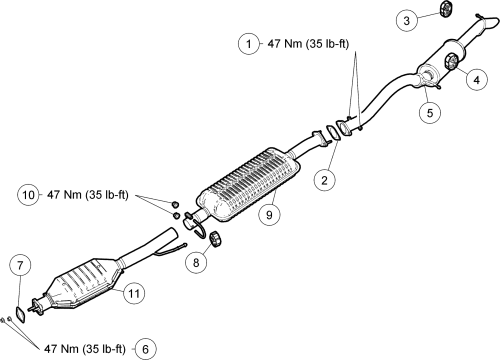
Welcome, gearheads! Today, we're diving deep into the exhaust system diagram of a 2005 Ford Escape. This isn't just a piece of paper; it's your roadmap for understanding, maintaining, and even modifying your Escape's exhaust system. Whether you're tackling a rattling heat shield, diagnosing a persistent Check Engine Light, or planning a performance upgrade, understanding this diagram is crucial.
Purpose of the 2005 Ford Escape Exhaust System Diagram
The exhaust system diagram, specifically for the 2005 Ford Escape, serves several vital purposes:
- Troubleshooting: It helps identify the location of specific components, like sensors or catalytic converters, enabling targeted diagnostics.
- Repair & Replacement: The diagram provides a visual reference for the sequence of parts and how they fit together, simplifying removal and installation.
- Modification: For those looking to upgrade their exhaust system, the diagram offers a crucial understanding of the existing layout, potential bottlenecks, and space constraints.
- Learning: Even if you're not actively working on your car, the diagram provides a valuable educational tool for understanding the function and interrelation of exhaust components.
Key Specs and Main Parts
The 2005 Ford Escape exhaust system, like most vehicles, is designed to safely and efficiently expel exhaust gases from the engine. Here are the main components and some important specs:
- Engine: The starting point. In 2005, the Escape came with several engine options, including a 2.3L inline-4 and a 3.0L V6. Each engine configuration slightly impacts the exhaust system layout.
- Exhaust Manifold(s): These collect exhaust gases directly from the engine's cylinders. The 2.3L has one, while the 3.0L has two (one for each bank of cylinders). They are typically made of cast iron or stainless steel.
- Catalytic Converter(s): This is a crucial emissions control device. Inside, precious metals (platinum, palladium, rhodium) catalyze chemical reactions to convert harmful pollutants (hydrocarbons, carbon monoxide, nitrogen oxides) into less harmful substances (water, carbon dioxide, nitrogen). The 2005 Escape typically has one or two catalytic converters, depending on the engine and emissions package.
- Oxygen (O2) Sensors: These sensors measure the oxygen content in the exhaust gas. There are typically two types: upstream sensors (before the catalytic converter) that help the engine control unit (ECU) adjust the air/fuel mixture, and downstream sensors (after the catalytic converter) that monitor the converter's efficiency.
- Muffler: The muffler reduces exhaust noise. It typically uses baffles and resonators to cancel out sound waves.
- Resonator (Sometimes): Some Escapes have a resonator, positioned before the muffler, to further dampen specific frequencies of exhaust noise.
- Exhaust Piping: These are the pipes that connect all the components. Common materials include aluminized steel and stainless steel. Pipe diameter is a key spec; larger diameter pipes can improve exhaust flow, but too large can reduce exhaust velocity and negatively impact performance. For the 2005 Escape, expect piping diameters around 2-2.25 inches.
- Heat Shields: These metal shields protect nearby components (fuel lines, brake lines, etc.) from the intense heat of the exhaust system. They're often the source of rattling noises when they corrode.
- Hangers/Mounts: Rubber or polyurethane hangers suspend the exhaust system from the vehicle's undercarriage. These are prone to wear and tear.
Symbols and Conventions in the Diagram
Understanding the symbols and conventions used in the diagram is essential for accurate interpretation:
- Lines: Solid lines typically represent exhaust pipes. Dashed lines might indicate vacuum lines associated with emissions control systems, or simply represent routing behind other components.
- Arrows: Arrows usually indicate the direction of exhaust gas flow.
- Shapes: Rectangles often represent components like the catalytic converter or muffler. Circles might indicate sensors. The shape legends are often on the sides or bottom of the diagram.
- Abbreviations: Common abbreviations include CAT (catalytic converter), O2S (oxygen sensor), MAN (manifold), and MFL (muffler).
- Component Numbers/Labels: Each component is usually labeled with a number or code. These codes can be cross-referenced with a parts list to identify the specific component.
- Color Coding: Some diagrams might use color coding to differentiate between components or materials. For example, red might indicate a hot section of the exhaust, while blue might indicate a sensor.
How the 2005 Ford Escape Exhaust System Works
The exhaust system's primary function is to safely remove combustion byproducts from the engine. Here's a simplified breakdown:
- Exhaust Gases Exit the Engine: Hot exhaust gases are expelled from the engine's cylinders into the exhaust manifold.
- Catalytic Conversion: The exhaust gases then flow through the catalytic converter(s), where harmful pollutants are converted into less harmful substances.
- Oxygen Sensor Feedback: Upstream oxygen sensors provide feedback to the ECU, allowing it to fine-tune the air/fuel mixture for optimal combustion and emissions control. Downstream oxygen sensors monitor the efficiency of the catalytic converter.
- Muffling: The exhaust gases then enter the muffler (and possibly a resonator), where sound waves are dampened to reduce noise.
- Exhaust Gas Exit: Finally, the exhaust gases exit the vehicle through the tailpipe.
Real-World Use: Basic Troubleshooting Tips
Here's how the exhaust system diagram can help with common problems:
- Rattling Noise: The diagram helps you locate heat shields and exhaust hangers. Check these components for corrosion, looseness, or breakage.
- Check Engine Light (CEL): If the CEL is related to emissions, the diagram helps you identify the location of oxygen sensors and the catalytic converter. Use a diagnostic scan tool to read the trouble codes. For example, a P0420 code ("Catalyst System Efficiency Below Threshold") suggests a problem with the catalytic converter or downstream oxygen sensor.
- Exhaust Leak: The diagram helps you trace the exhaust system to visually inspect for cracks, holes, or loose connections. Pay close attention to joints and welds.
- Poor Fuel Economy: A malfunctioning oxygen sensor can negatively impact fuel economy. The diagram helps you locate and test the sensors.
Safety Considerations
Working on the exhaust system can be dangerous. Here are some important safety precautions:
- Heat: The exhaust system gets extremely hot. Never work on the exhaust system immediately after the engine has been running. Allow it to cool completely.
- Lifting the Vehicle: Use proper jack stands to support the vehicle safely. Never work under a vehicle supported only by a jack.
- Eye Protection: Wear safety glasses to protect your eyes from debris.
- Gloves: Wear gloves to protect your hands from burns and sharp edges.
- Carbon Monoxide: Carbon monoxide is a deadly, odorless gas. Always work in a well-ventilated area. Never run the engine in a closed garage.
- O2 Sensors: Exercise caution when working with oxygen sensors, especially removing them. They can be seized in place and require specialized tools to remove without damaging the threads in the exhaust manifold.
This detailed explanation, along with a high-quality exhaust system diagram, is a powerful tool for anyone looking to understand, maintain, or modify the exhaust system of their 2005 Ford Escape. With a little knowledge and careful work, you can save money and keep your Escape running smoothly.
We have the full, printable PDF file of the 2005 Ford Escape Exhaust System Diagram ready for you. Contact us to download it and take your understanding to the next level!