
2008 Chevy Impala Exhaust System Diagram
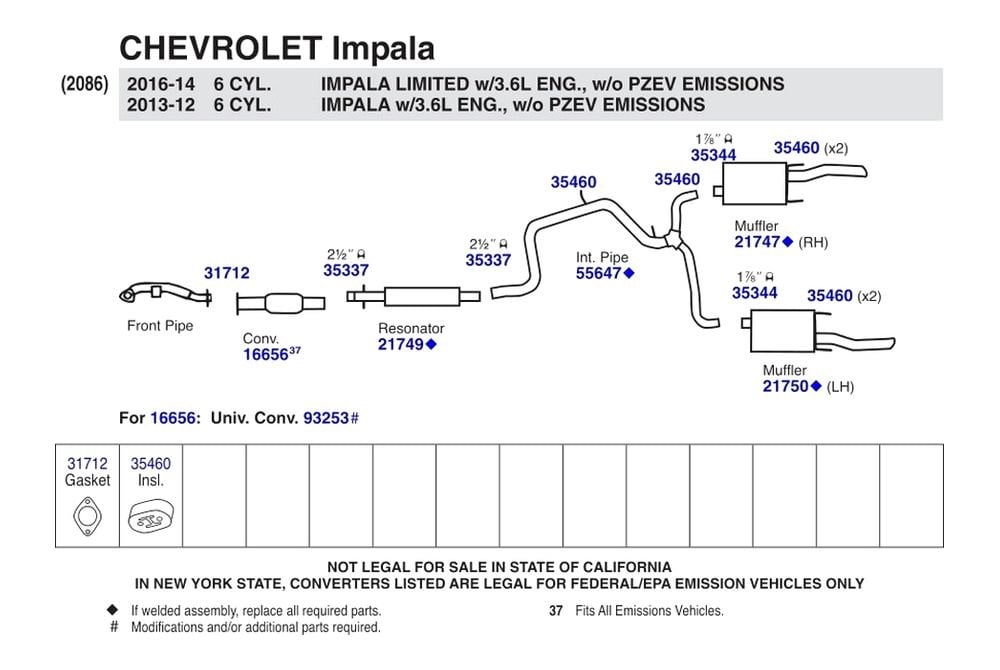
Alright, let's dive into the exhaust system of a 2008 Chevy Impala. This isn't just about understanding where the pipes go; it's about having the knowledge to diagnose problems, perform repairs, and even consider performance upgrades. Having a solid grasp of your exhaust system, especially armed with a good diagram, can save you money and give you a deeper understanding of your vehicle. We've got a downloadable diagram available for you, and this article will walk you through how to interpret it.
Why an Exhaust System Diagram Matters
The exhaust system is more than just a way to get rid of fumes. It plays a critical role in your engine's performance, fuel efficiency, and emissions control. A diagram is invaluable for several reasons:
- Diagnostics: Identifying the exact location of leaks (which can cause reduced fuel economy and emissions failures).
- Repair: Replacing damaged components, such as mufflers, resonators, or catalytic converters.
- Modification: Planning and executing exhaust upgrades for improved performance.
- Learning: Gaining a fundamental understanding of how the exhaust system functions within the overall vehicle.
Key Specs and Main Parts of the 2008 Impala Exhaust
The 2008 Chevy Impala's exhaust system, like most modern vehicles, is a complex network designed to efficiently expel exhaust gases while minimizing emissions and noise. Here's a breakdown of the key components:
- Exhaust Manifold(s): These are bolted directly to the engine's cylinder head(s). Their purpose is to collect the exhaust gases from each cylinder and funnel them into a single pipe. The Impala, depending on the engine (3.5L, 3.9L V6 or 5.3L V8), might have one or two exhaust manifolds. The 5.3L V8 will have two.
- Catalytic Converter(s): This is a crucial emissions control device. It uses a catalyst (usually platinum, palladium, and rhodium) to convert harmful pollutants like hydrocarbons (HC), carbon monoxide (CO), and nitrogen oxides (NOx) into less harmful substances like carbon dioxide (CO2), water (H2O), and nitrogen (N2). 2008 Impalas have one or two catalytic converters, depending on the engine configuration. The 5.3L will have two.
- Oxygen Sensors (O2 Sensors): These sensors monitor the oxygen content in the exhaust stream. There are typically two types: upstream (before the catalytic converter) and downstream (after the catalytic converter). The upstream sensor is critical for fuel mixture control, while the downstream sensor monitors the catalytic converter's efficiency.
- Resonator: This is a chamber designed to reduce specific frequencies of sound, helping to quiet the exhaust.
- Muffler: This is the primary noise reduction device in the exhaust system. It uses a series of chambers and baffles to dampen sound waves.
- Exhaust Pipes: These are the pipes that connect all the other components together. They are typically made of steel, often aluminized for corrosion resistance.
- Hangers and Mounts: These rubber or metal supports hold the exhaust system in place and prevent it from rattling against the vehicle's undercarriage.
- Gaskets and Flanges: These are used to seal the joints between different exhaust components, preventing leaks.
Understanding Exhaust System Diagram Symbols
Diagrams often use symbols and conventions to represent different parts and connections. Here's what you should look for in our downloadable diagram:
- Lines: Solid lines typically represent exhaust pipes. Dashed lines might indicate vacuum lines or other related components (e.g., for an exhaust cutout valve, if equipped).
- Colors: Colors can be used to distinguish different sections of the exhaust system or to highlight specific components. For example, the catalytic converter might be shaded in a different color.
- Component Icons: Symbols will represent specific components like mufflers (usually a rounded rectangle), catalytic converters (often a rectangular box with internal features), and oxygen sensors (typically a circle with wires extending from it).
- Arrows: Arrows indicate the direction of exhaust flow.
- Labels: Each component is usually labeled with a name or a part number. The diagram will have corresponding legend, which explains the part number.
- Mounting Points: The diagram will show the location of the mounting points and hangers.
How the Exhaust System Works
The process begins when the engine's exhaust valves open, releasing burnt gases from the combustion chambers into the exhaust manifold. The manifold collects these gases and directs them towards the catalytic converter. Inside the catalytic converter, a chemical reaction occurs, converting harmful pollutants into less harmful substances. From there, the exhaust gases flow through the resonator (if equipped) and then the muffler, where sound waves are dampened. Finally, the exhaust gases are expelled from the tailpipe into the atmosphere. The entire system is designed to reduce emissions and noise.
Oxygen sensors play a crucial role in this process. The upstream sensor provides feedback to the engine control unit (ECU) about the air-fuel ratio. The ECU then adjusts the fuel injection to maintain an optimal mixture for efficient combustion and minimal emissions. The downstream sensor monitors the effectiveness of the catalytic converter. If the downstream sensor detects excessive levels of pollutants, it signals a problem with the converter, which will often trigger the "Check Engine" light.
Real-World Use: Basic Troubleshooting
Here are a few common problems you might encounter with your 2008 Impala's exhaust system, and how the diagram can help you troubleshoot:
- Exhaust Leak: A hissing or roaring sound, especially under acceleration, often indicates an exhaust leak. Use the diagram to locate the flanges and joints in the system. Visually inspect these areas for signs of damage or corrosion. A telltale sign of a leak is black soot around a joint.
- Rattling Noise: A rattling noise could be caused by a loose hanger or a damaged heat shield. The diagram shows the location of the hangers and heat shields, allowing you to quickly inspect them.
- Check Engine Light (P0420 Code): This code often indicates a problem with the catalytic converter's efficiency. Use the diagram to identify the location of the downstream oxygen sensor. Check the sensor's wiring and connector for damage. If the wiring is good, the sensor itself might be faulty, or the catalytic converter might need to be replaced.
- Poor Fuel Economy: An exhaust leak or a malfunctioning oxygen sensor can affect fuel economy. Use the diagram to check for leaks and inspect the oxygen sensor wiring.
Safety Considerations
Working on an exhaust system can be dangerous. Here are some important safety precautions:
- Hot Exhaust: Always allow the exhaust system to cool completely before working on it. Exhaust pipes can reach extremely high temperatures and cause severe burns.
- Jack Stands: Never work under a vehicle supported only by a jack. Use jack stands to provide secure support.
- Eye Protection: Wear safety glasses to protect your eyes from debris and rust.
- Gloves: Wear gloves to protect your hands from cuts and burns.
- Ventilation: Work in a well-ventilated area to avoid inhaling exhaust fumes.
- Catalytic Converter: Be extremely careful when handling a catalytic converter. It can contain harmful materials. Dispose of it properly at a recycling center.
Remember, the catalytic converter operates at extremely high temperatures, potentially over 1200 degrees Fahrenheit. Exercise extreme caution when working near it, even after the engine has been off for a considerable amount of time.
With this knowledge and the downloadable diagram, you'll be well-equipped to understand, maintain, and even modify your 2008 Chevy Impala's exhaust system. It will help you diagnose problems quickly, and allow you to make informed decisions when choosing the correct parts to purchase.
Now, let's get that diagram downloaded so you can have a visual reference while working!