
2010 Chevy Malibu Exhaust System Diagram
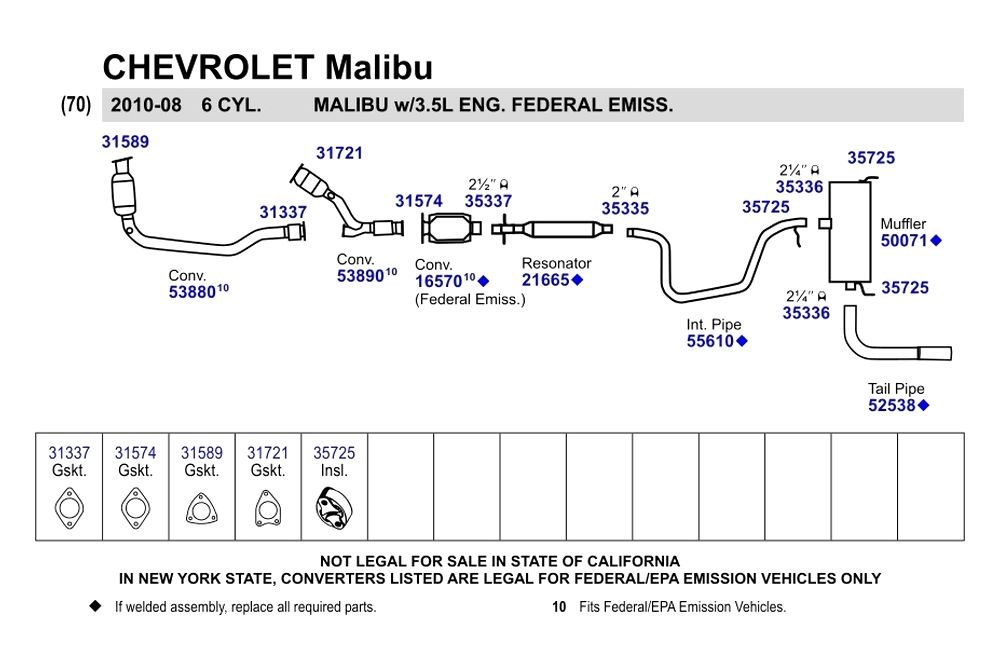
So, you're looking to understand the exhaust system on your 2010 Chevy Malibu? Smart move! Whether you're diagnosing a noisy exhaust, planning some upgrades, or just want a better grasp of how your car works, a detailed exhaust system diagram is invaluable. We're going to break down the diagram for the 2010 Malibu, so you can confidently tackle your automotive endeavors. We even have the diagram available for you to download (link at the end), so you can follow along visually.
Purpose of Understanding the Exhaust Diagram
Why bother with an exhaust diagram? Several reasons:
- Troubleshooting: Is your Malibu suddenly loud? Identifying the source of the leak – a cracked pipe, a blown gasket, or a failing muffler – becomes far easier with a visual guide.
- Repair and Replacement: Knowing the exact layout and component locations is crucial when replacing parts. You'll avoid unnecessary work and ensure you order the correct parts.
- Modification: Thinking of upgrading your exhaust system? A diagram shows you the existing configuration, allowing you to plan modifications effectively and understand potential performance implications.
- General Knowledge: Even if you're not actively working on your car, understanding its systems fosters a deeper appreciation for automotive engineering.
Key Specs and Main Parts of the 2010 Chevy Malibu Exhaust System
The 2010 Chevy Malibu, depending on the engine (2.4L 4-cylinder or 3.6L V6), will have slight variations in its exhaust system, but the basic principles and components remain the same. Here's a breakdown:
- Exhaust Manifold(s): These are bolted directly to the engine cylinder head(s). They collect exhaust gases from each cylinder and channel them into a single (or multiple, in the case of the V6) exhaust pipe(s). Expect them to be made of cast iron or, sometimes, stainless steel for better performance.
- Catalytic Converter(s): These are the emission control devices that reduce harmful pollutants (hydrocarbons, carbon monoxide, and nitrogen oxides) in the exhaust gases. They use catalysts to convert these pollutants into less harmful substances like carbon dioxide, water, and nitrogen. The 2010 Malibu typically has one or two catalytic converters, depending on the engine. Failure of a catalytic converter often triggers a "Check Engine" light.
- Oxygen Sensors (O2 Sensors): These sensors measure the amount of oxygen in the exhaust stream. There are usually two types: upstream (before the catalytic converter) and downstream (after the catalytic converter). The engine control unit (ECU) uses this information to optimize the air-fuel mixture for efficient combustion and emissions control. Faulty O2 sensors can impact fuel economy and performance.
- Resonator: Often located before the muffler, the resonator helps to reduce noise levels and control exhaust tone. It typically looks like a small muffler.
- Muffler: This is the primary noise-reducing component of the exhaust system. It uses internal chambers and baffles to dampen sound waves. A rusted-out muffler is a common cause of exhaust noise.
- Exhaust Pipes: These are the connecting pipes that carry exhaust gases between the various components. They are typically made of steel and can be single or dual, depending on the vehicle configuration.
- Hangers and Mounts: These rubber or metal brackets secure the exhaust system to the undercarriage of the vehicle, preventing it from vibrating and causing damage.
- Gaskets and Flanges: Gaskets create a seal between the exhaust components to prevent leaks. Flanges are the mating surfaces where the components are bolted together. Exhaust leaks often occur at gasket and flange connections.
Understanding Symbols on the Exhaust Diagram
Exhaust diagrams often use standardized symbols to represent different components and features. Here's what you might encounter:
- Solid Lines: Represent exhaust pipes. Different thicknesses might indicate pipe diameter.
- Dashed Lines: May represent vacuum lines or other related systems that interact with the exhaust.
- Rectangles/Squares: Often used to represent the catalytic converter, muffler, or resonator. The diagram may contain notations like "CAT," "MUF," or "RES" inside the rectangles.
- Circles: Typically used to represent sensors, such as O2 sensors. A label like "O2S1" (Oxygen Sensor 1) will identify its location (e.g., upstream).
- Arrows: Indicate the direction of exhaust gas flow.
- Numbers/Codes: These correspond to part numbers or reference points for specific components.
Color-coding is less common in exhaust diagrams than in, say, wiring diagrams. However, if your diagram uses color, a key should be provided to explain the meaning of each color. Usually, the color is added to the pipe or part for easier identification.
How the 2010 Chevy Malibu Exhaust System Works
The exhaust system's primary function is to safely and efficiently remove exhaust gases from the engine and reduce harmful emissions and noise. Here's the process:
- Combustion: Fuel is burned inside the engine cylinders, producing exhaust gases.
- Exhaust Manifold: The exhaust gases are collected by the exhaust manifold(s).
- Catalytic Converter(s): The exhaust gases pass through the catalytic converter(s), where harmful pollutants are converted into less harmful substances.
- Oxygen Sensors: Upstream O2 sensors monitor the exhaust gas composition *before* the catalytic converter, providing feedback to the ECU for air-fuel mixture control. Downstream O2 sensors monitor the *effectiveness* of the catalytic converter.
- Resonator (if equipped): The exhaust gases pass through the resonator, which helps to reduce noise and control exhaust tone.
- Muffler: The exhaust gases pass through the muffler, which further reduces noise.
- Tailpipe: Finally, the exhaust gases are expelled through the tailpipe into the atmosphere.
Real-World Use: Basic Troubleshooting Tips
Here are some common issues you might encounter and how the exhaust diagram can help:
- Loud Exhaust: Use the diagram to visually inspect for cracks, holes, or loose connections in the exhaust pipes, muffler, or resonator. Check the gaskets at the flanges.
- Rattling Noise: The diagram can help you identify the location of exhaust hangers. Check if any are broken or loose, causing the exhaust system to rattle against the undercarriage.
- Check Engine Light (P0420 Code - Catalytic Converter Efficiency): Use the diagram to locate the downstream O2 sensor. A faulty downstream O2 sensor or a failing catalytic converter can trigger this code. Remember, replacing the O2 sensor is often the first (and cheaper) step.
- Poor Fuel Economy: Leaks in the exhaust system, especially near the O2 sensors, can affect the air-fuel mixture and reduce fuel economy. Use the diagram to inspect for leaks.
Safety Precautions
Working on the exhaust system can be dangerous. Here are some crucial safety precautions:
- Hot Exhaust: Never work on the exhaust system when the engine is hot. Allow it to cool down completely. Exhaust pipes can reach extremely high temperatures and cause severe burns.
- Jack Stands: If you need to lift the vehicle, use jack stands to support it safely. Never rely solely on a jack.
- Eye Protection: Wear safety glasses to protect your eyes from debris.
- Gloves: Wear gloves to protect your hands from dirt, rust, and sharp edges.
- Carbon Monoxide: Never run the engine in an enclosed space while working on the exhaust system. Carbon monoxide is a colorless, odorless, and deadly gas.
- Penetrating Oil: Use penetrating oil to loosen rusted bolts and nuts.
The catalytic converter contains precious metals and can be a target for theft. Consider security measures to deter theft.
With the information above, you're well-equipped to start understanding your 2010 Chevy Malibu's exhaust system. To help even more, we have the full exhaust system diagram file for you. You can download it here. Good luck with your project!