
Camshaft Position Sensor Connector Wiring
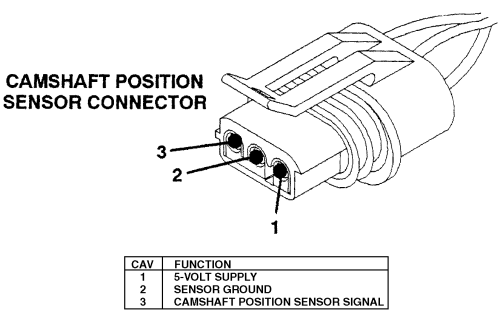
Alright, let's dive into the fascinating world of Camshaft Position (CMP) Sensor connector wiring. You might be looking at this because you're tackling a repair, trying to understand your engine's operation better, or maybe even planning a modification. Regardless, understanding this wiring is crucial for ensuring your engine runs smoothly and avoids those dreaded "check engine" lights.
Why This Diagram Matters
Think of the CMP sensor as a vital messenger in your engine's computer system. It reports the position of the camshaft to the Engine Control Unit (ECU), also sometimes referred to as the Powertrain Control Module (PCM). This information is critical for the ECU to calculate when to fire the fuel injectors and when to ignite the spark plugs. Incorrect or missing CMP signal means misfires, poor performance, and potentially even a no-start condition. A solid understanding of the connector wiring empowers you to:
- Diagnose problems accurately: Pinpointing wiring faults becomes much easier.
- Perform repairs confidently: You can replace damaged connectors or wiring without guesswork.
- Avoid costly shop visits: Armed with knowledge, you can handle many common issues yourself.
- Understand engine operation: Gain a deeper understanding of how your engine's timing system works.
Key Specs and Main Parts
Before we dissect the wiring diagram, let's identify the key components. The star of the show is, of course, the CMP sensor itself. These come in various types, but the most common are Hall-effect sensors.
- CMP Sensor: The device that detects the camshaft's position, converting it into an electrical signal. Hall-effect sensors use a magnetic field and a semiconductor to produce a voltage signal proportional to the camshaft's position.
- Connector: This is where the wiring diagram becomes essential. The connector provides the physical interface between the sensor and the wiring harness. It's typically a three-wire connector, although some variations exist.
- Wiring Harness: The bundle of wires that connects the CMP sensor to the ECU (or PCM).
- ECU (Engine Control Unit): The "brain" of the engine. It receives the CMP sensor signal and uses it to control fuel injection and ignition timing.
Typical specifications to keep in mind when working with CMP sensors and their wiring include:
- Operating Voltage: Usually 5V DC, supplied by the ECU.
- Signal Voltage: Varies depending on the camshaft position. Typically swings between 0V and 5V.
- Wire Gauge: Often 18-22 AWG (American Wire Gauge).
- Connector Type: Varies by manufacturer and model; look for markings or part numbers.
Understanding the Wiring Diagram Symbols
Now, let's crack the code of the wiring diagram. These diagrams may seem intimidating at first, but with a little practice, you'll be reading them like a pro. Here's a breakdown of common symbols:
- Solid Lines: Represent wires. A thicker line might indicate a larger gauge wire.
- Dashed Lines: Sometimes represent shielding around a wire or a connection point.
- Colors: Each wire is typically color-coded. For example, "RED" (RD), "BLACK" (BK), "WHITE" (WH), "GREEN" (GR), "BLUE" (BL), "YELLOW" (YE). These are crucial for identification. Always verify wire colors with a wiring diagram specific to your vehicle!
- Connector Symbols: Usually represented by a rectangle with pins or terminals inside. Each pin is numbered or lettered.
- Ground Symbol: Looks like an inverted pyramid or a series of horizontal lines decreasing in size. Indicates a connection to the vehicle's chassis ground.
- Voltage Source Symbol: Often a circle with a "+" inside, indicating the power supply (usually 5V from the ECU).
- Splice Points: Where multiple wires are joined together.
A typical CMP sensor connector has three wires:
- Power Supply (5V): This wire provides the necessary voltage for the sensor to operate.
- Ground: This wire provides a return path for the electrical current.
- Signal Wire: This wire carries the camshaft position signal back to the ECU.
How It Works: From Camshaft to ECU
The CMP sensor works in tandem with a toothed wheel or reluctor ring attached to the camshaft. As the camshaft rotates, the teeth on the wheel pass by the sensor. In the case of a Hall-effect sensor, each passing tooth disrupts the magnetic field, causing the sensor to generate a pulse. The frequency and pattern of these pulses correlate directly to the camshaft's speed and position.
The CMP sensor sends this pulsed signal to the ECU. The ECU interprets these pulses to determine the exact position of the camshaft. This information is then used to precisely control the timing of fuel injection and ignition. Without a clear and accurate CMP signal, the ECU cannot perform these critical functions, leading to engine performance problems.
Real-World Use: Basic Troubleshooting
If you suspect a problem with your CMP sensor or its wiring, here are some basic troubleshooting steps:
- Visual Inspection: Check the connector for any signs of damage, corrosion, or loose wires. Make sure the connector is securely attached to the sensor.
- Wiring Continuity Test: Use a multimeter to check the continuity of each wire between the connector and the ECU. This ensures that the wires are not broken or shorted. Set your multimeter to the continuity setting (often denoted by a sound wave symbol). Remove the connector from both the CMP sensor and the ECU. Place one probe on a pin on the connector and the other probe on the corresponding pin at the ECU connector. A beep or a reading close to zero ohms indicates continuity. Repeat for each wire.
- Voltage Test: With the ignition ON (but engine OFF), use a multimeter to check for the presence of 5V on the power supply wire at the connector. Also, check that the ground wire has a good connection to ground (close to zero ohms resistance between the ground pin and a known good ground point on the chassis).
- Signal Wire Check: With the engine running, use a multimeter or oscilloscope to check the signal wire. You should see a pulsating voltage signal that corresponds to the camshaft's rotation. An oscilloscope provides the most detailed view of the signal.
- Scan for Codes: Use an OBD-II scanner to check for any Diagnostic Trouble Codes (DTCs) related to the CMP sensor (e.g., P0340, P0341). These codes can provide valuable clues about the nature of the problem.
Important Note: Always refer to your vehicle's specific service manual for detailed wiring diagrams and testing procedures. Generic information can be helpful, but it's no substitute for accurate, vehicle-specific data.
Safety First!
Working on electrical systems can be dangerous if proper precautions are not taken. Here are some important safety tips:
- Disconnect the Battery: Before working on any electrical components, disconnect the negative battery terminal to prevent accidental shorts or shocks.
- Use Proper Tools: Use insulated tools designed for automotive electrical work.
- Be Careful with Wiring: Avoid pulling or tugging on wires, as this can damage them or disconnect them from their terminals.
- Avoid Water: Never work on electrical systems in wet conditions.
- High Voltage Components: Be particularly cautious around ignition components (like the ignition coil), which can carry very high voltages even after the engine is turned off. Always discharge capacitors before handling ignition coils.
By understanding the CMP sensor connector wiring, you'll be well-equipped to diagnose and repair a wide range of engine performance problems. You'll also gain a deeper understanding of how your engine operates, which is always a worthwhile pursuit for any DIY enthusiast.
We have a detailed diagram available for download that covers various CMP sensor wiring configurations. It's a valuable resource that you can keep on hand for future reference. Contact us to obtain the file!