
Diagram Ford Ranger 5 Speed Manual Transmission
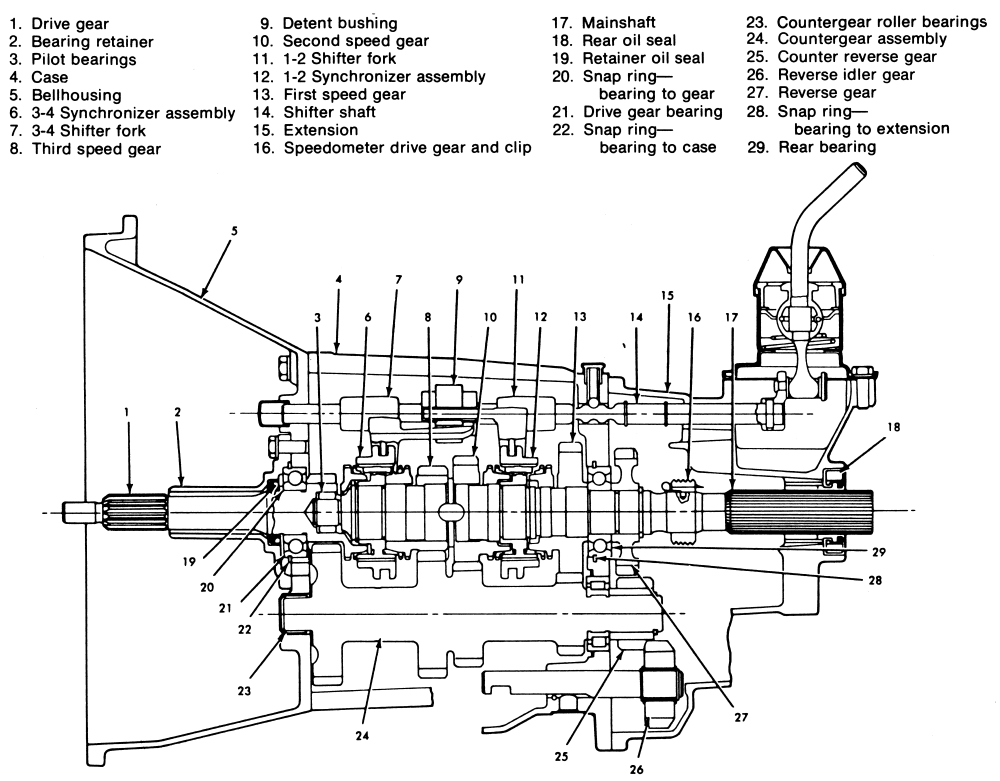
So, you're looking under the hood (metaphorically, for now!) of your Ford Ranger's 5-speed manual transmission. Whether you're planning a repair, trying to diagnose a problem, or just want to understand how the guts of your truck work, having a good diagram is essential. This article will break down a typical Ford Ranger 5-speed manual transmission diagram, making it accessible even if you're not a seasoned transmission specialist.
Purpose of a Transmission Diagram
Why bother with a diagram? Simple: it's your roadmap inside the transmission. It serves several vital purposes:
- Diagnosis: Pinpointing the source of a noise, vibration, or shifting issue.
- Repair: Guiding disassembly, component replacement, and reassembly.
- Modification: Planning gear swaps or other performance upgrades.
- Learning: Comprehending the flow of power and the interaction of different parts.
Without a diagram, you're essentially disassembling a complex machine blindfolded. A good diagram, coupled with a repair manual, dramatically increases your chances of a successful repair and avoids costly mistakes.
Key Specs and Main Parts
Before diving into the diagram itself, let's cover some common specifications and the main components you'll encounter in most Ford Ranger 5-speed manual transmissions (specifics may vary slightly by year and model):
Specifications:
- Transmission Type: Typically a Mazda M5OD-R1 or similar variant. These are longitudinally mounted, meaning they sit in line with the vehicle and transmit power through a driveshaft.
- Gear Ratios: Vary depending on the year and engine, but generally feature a low first gear for off-road and towing, and an overdrive fifth gear for fuel efficiency. Knowing your gear ratios is crucial if you're considering a gear swap.
- Fluid Type: Often uses Mercon ATF (Automatic Transmission Fluid), not gear oil. Using the wrong fluid can cause serious damage. Always consult your owner's manual or a reliable service guide.
Main Parts:
- Input Shaft: Receives power directly from the engine via the clutch.
- Output Shaft: Transmits power to the driveshaft and then to the rear axle.
- Countershaft (or Layshaft): An intermediate shaft that carries gears used to transmit power between the input and output shafts.
- Gears: Helical-cut gears are common for quieter operation. Each gear ratio is achieved by engaging a different gear on the countershaft with a corresponding gear on the output shaft.
- Synchronizers: These are crucial components that equalize the speed of the gear being selected with the output shaft speed, allowing for smooth, clash-free shifting. Worn synchronizers are a common cause of grinding when shifting.
- Shift Forks: Move the synchronizer sleeves to engage the desired gear.
- Shift Rails: Rods that the shift forks slide along, controlled by the shifter mechanism.
- Shift Lever (or Shifter): The mechanical link between you and the transmission.
- Bearing Retainers: Secure the bearings that support the shafts.
- Transmission Case: The housing that contains all the internal components.
- Seals: Prevent fluid leaks.
Understanding the Diagram: Symbols and Conventions
A transmission diagram isn't a photograph. It's a schematic representation, using symbols and conventions to illustrate the relationships between parts.
- Lines:
- Solid Lines: Generally represent mechanical connections or the outlines of parts.
- Dashed Lines: May indicate fluid passages, hidden components, or the path of movement.
- Circles: Often represent bearings or seals.
- Hatching: Indicates a cutaway view, showing internal details.
- Arrows: Show the direction of rotation or movement.
- Abbreviations: You'll see many abbreviations, such as "IS" for Input Shaft, "OS" for Output Shaft, "CS" for Countershaft, "Synchro" for Synchronizer, etc.
Some diagrams may use color-coding to differentiate parts or highlight specific functions. Always refer to the diagram's legend to understand the meaning of each symbol and color.
How It Works: A Simplified Explanation
At its core, a manual transmission allows you to select different gear ratios to match the engine's power output to the driving conditions. Here's a simplified overview:
- The input shaft spins at the same speed as the engine (when the clutch is engaged).
- Power is transferred from the input shaft to the countershaft via a set of gears. The countershaft constantly spins whenever the engine is running.
- The output shaft has a set of gears that are always meshed with the corresponding gears on the countershaft. However, these gears on the output shaft are free to spin independently of the output shaft itself – until a gear is selected.
- When you move the shift lever, you're actuating a shift fork. The shift fork pushes a synchronizer sleeve onto a gear on the output shaft.
- The synchronizer sleeve engages with the selected gear, locking it to the output shaft. Now, the output shaft spins at the speed dictated by the gear ratio of the selected gear pair.
- This rotational force is then transmitted to the driveshaft and eventually to the wheels.
Different gear ratios provide different levels of torque multiplication. Lower gears (1st, 2nd) provide more torque for acceleration and climbing, while higher gears (4th, 5th) provide lower torque but higher speeds and better fuel economy.
Real-World Use: Basic Troubleshooting
Knowing how the transmission works and having a diagram is invaluable for troubleshooting. Here are a few common issues and how a diagram can help:
- Grinding When Shifting: Often caused by worn synchronizers. The diagram can help you locate and identify the synchronizers associated with the problematic gear.
- Difficulty Shifting into a Specific Gear: Could be a problem with the shift fork, shift rail, or a damaged gear. The diagram shows how these components interact, allowing you to trace the path of movement and identify potential sticking points.
- Transmission Noise: Can be caused by worn bearings, damaged gears, or low fluid level. The diagram helps you identify the location of the bearings and gears, making it easier to pinpoint the source of the noise.
- Fluid Leaks: Leaks can occur at the seals around the input shaft, output shaft, or transmission case. The diagram shows the location of these seals, allowing you to inspect them for damage.
Important: Always start with the simplest checks first, such as fluid level and shifter linkage adjustment, before tearing into the transmission.
Safety Considerations
Working on a transmission can be dangerous. Here are some safety precautions:
- Weight: Transmissions are heavy! Use a transmission jack to support the transmission during removal and installation. Never attempt to lift a transmission by hand.
- Sharp Edges: Internal transmission components can have sharp edges. Wear gloves to protect your hands.
- Springs: Many parts are held in place with springs. Be careful when disassembling to avoid injury from flying springs.
- Fluid: Transmission fluid can be hot and slippery. Wear appropriate clothing and footwear. Dispose of used fluid properly.
Pay special attention to the input shaft and output shaft seals. Damage to these seals is a common cause of leaks, and replacing them often requires special tools. Always use the correct torque specifications when reassembling the transmission to prevent damage to the case or components.
Always disconnect the battery before working on any electrical components related to the transmission, such as the neutral safety switch or the reverse lights switch.
By carefully studying the diagram and understanding the function of each component, you can significantly increase your confidence and success when working on your Ford Ranger's 5-speed manual transmission.
We have the file of the detailed Ford Ranger 5-Speed Manual Transmission diagram. You can download it by clicking the link below.