
Ford Throttle Position Sensor Wiring Diagram
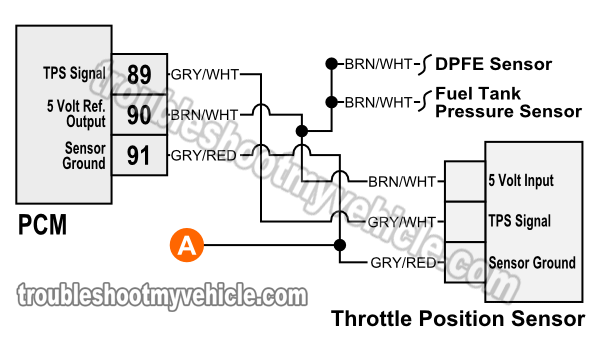
Alright, let's dive into the Ford Throttle Position Sensor (TPS) wiring diagram. If you're tinkering with your Ford's engine performance, diagnosing idle issues, or even just trying to understand how your car ticks, knowing your way around the TPS wiring is crucial. We're not just talking about replacing a sensor here; we're talking about understanding the entire circuit, which can save you time, money, and a whole lot of frustration.
Purpose of Understanding the TPS Wiring Diagram
Why bother with a wiring diagram? Simple. It’s your roadmap to the TPS circuit. It allows you to:
- Diagnose Problems Accurately: Instead of randomly swapping parts, a wiring diagram helps you pinpoint the exact location of a fault – a broken wire, a short to ground, or a bad connection.
- Perform Repairs Safely and Effectively: Knowing the wiring layout ensures you're not cutting the wrong wire or creating new problems while fixing old ones.
- Understand Engine Control: The TPS is a critical input to the Engine Control Unit (ECU), also known as the Powertrain Control Module (PCM). Understanding its wiring is key to understanding how the ECU interprets throttle position.
- Customize or Modify Your Vehicle: Whether you're installing aftermarket parts or modifying your engine, the wiring diagram is invaluable for integrating new components into the existing system.
- Learn About Automotive Electronics: This is more than just a diagram; it's a lesson in how automotive sensors and control systems work.
Key Specs and Main Parts of the TPS Circuit
Before we dissect the diagram, let's identify the key players in the TPS circuit:
- Throttle Position Sensor (TPS): This is the star of the show. It's a potentiometer, which is basically a variable resistor. As the throttle plate moves, the TPS sends a varying voltage signal to the ECU, indicating the throttle position.
- Engine Control Unit (ECU) / Powertrain Control Module (PCM): The brain of the operation. The ECU receives the TPS signal and uses it, along with other sensor inputs, to calculate the correct fuel injection, ignition timing, and other parameters.
- Wiring Harness: This is the network of wires that connects the TPS to the ECU and the power source.
- Connectors: These provide secure electrical connections between the TPS, the wiring harness, and the ECU. Corrosion or loose connections here are common culprits in TPS-related problems.
- Power Source: Typically, the TPS receives a 5-volt reference voltage from the ECU.
- Ground: The TPS also needs a reliable ground connection to complete the circuit.
Expect to see a 3-wire connection at the TPS connector, usually. The specifications may vary slightly depending on the specific Ford model and year, but the general principle remains the same.
Symbols: Decoding the Ford TPS Wiring Diagram
Wiring diagrams use standard symbols to represent electrical components and connections. Here's a breakdown of what you'll typically find in a Ford TPS wiring diagram:
- Solid Lines: Represent wires. The thickness of the line doesn't usually indicate wire gauge, but rather serves to visually distinguish different connections.
- Dashed Lines: May indicate shielded wiring or connections that are internal to a module (like inside the ECU).
- Circles: Can represent terminals or connections.
- Rectangles: Often represent components like relays or modules (ECU).
- Resistor Symbol (Zig-zag line): Used to represent a fixed resistor, but within the TPS it represents the resistive element of the potentiometer.
- Ground Symbol (Downward pointing triangle or series of lines getting shorter): Indicates a connection to ground (chassis or engine block).
- Voltage Source Symbol (Line with + and - signs): Indicates a voltage source, usually the 5V reference voltage from the ECU.
- Color Codes: Wires are often color-coded. For example:
- WH: White
- BK: Black
- RD: Red
- GN: Green
- YE: Yellow
- BL: Blue
- Numbers and Letters: These identify specific wires and connector pins. Tracing these numbers is essential for diagnosing wiring problems. Pay attention to the pin numbers at the TPS connector and at the ECU connector.
Remember, every diagram has a legend. Always refer to the legend to understand the specific symbols and abbreviations used in your particular diagram.
How It Works: The TPS Circuit in Action
Here’s a simplified explanation of how the TPS circuit works:
- The ECU sends a 5-volt reference voltage to the TPS.
- The TPS acts as a voltage divider. As you move the throttle, the internal potentiometer changes its resistance.
- This change in resistance alters the voltage signal sent back to the ECU. At closed throttle, the voltage is typically low (around 0.5V). At wide-open throttle (WOT), the voltage is typically high (around 4.5V).
- The ECU reads this voltage signal and interprets it as the throttle position.
- Based on the throttle position, the ECU adjusts the fuel injection, ignition timing, and other parameters to optimize engine performance.
The key is that the TPS provides a variable voltage signal, not just an on/off signal. This allows the ECU to precisely control the engine based on the driver's throttle input.
Real-World Use: Basic Troubleshooting Tips
Here are a few basic troubleshooting tips you can use with the TPS wiring diagram:
- Check for Voltage: Use a multimeter to verify that the TPS is receiving the 5-volt reference voltage from the ECU. If there's no voltage, check the wiring and the ECU connector.
- Check the Ground Connection: Ensure the TPS has a good ground connection. Use a multimeter to check the resistance between the TPS ground terminal and the chassis. It should be very low (close to 0 ohms).
- Check the Signal Wire: With the ignition on (but engine off), backprobe the TPS signal wire and slowly move the throttle. You should see a smooth and gradual change in voltage as the throttle moves from closed to open. Spikes or dropouts in the voltage signal indicate a faulty TPS.
- Check for Shorts: Use a multimeter to check for shorts to ground or shorts to the 12V system on the TPS wires.
- Inspect Connectors: Carefully inspect the TPS connector and the ECU connector for corrosion, loose pins, or damaged wiring. Clean the connectors with electrical contact cleaner if necessary.
- Consult Diagnostic Trouble Codes (DTCs): Use an OBD-II scanner to check for any TPS-related trouble codes. These codes can provide valuable clues about the nature of the problem. Codes like P0120, P0121, P0122, and P0123 are common TPS-related DTCs.
Safety First: Handling Risky Components
Working with automotive electrical systems can be dangerous. Keep these safety tips in mind:
- Disconnect the Battery: Always disconnect the negative battery cable before working on any electrical components. This will prevent accidental shorts and electrical shocks.
- Be Careful with the ECU: The ECU is a sensitive electronic device. Avoid static electricity and handle it with care. Never probe the ECU connector with sharp objects, as this can damage the pins.
- Use Proper Tools: Use a multimeter with sharp probes to safely backprobe connectors without damaging the wires.
- Work in a Well-Ventilated Area: Some electrical contact cleaners and solvents can be harmful if inhaled.
- If in Doubt, Seek Professional Help: If you're not comfortable working on the electrical system, take your car to a qualified mechanic.
Remember, some components related to the fuel system are also nearby. Exercise extreme caution to avoid sparks or open flames when working around the fuel system. Fuel vapors are highly flammable.
Understanding the Ford TPS wiring diagram empowers you to diagnose and repair your vehicle more effectively. It's a valuable tool for any DIY mechanic or car enthusiast. By following the safety precautions and taking your time, you can confidently tackle TPS-related problems and keep your Ford running smoothly.
To help you get started, we've prepared a downloadable Ford TPS wiring diagram file. You can use this file as a reference while working on your vehicle.