
Power Wheels 12v Ride On Car Wiring Diagram
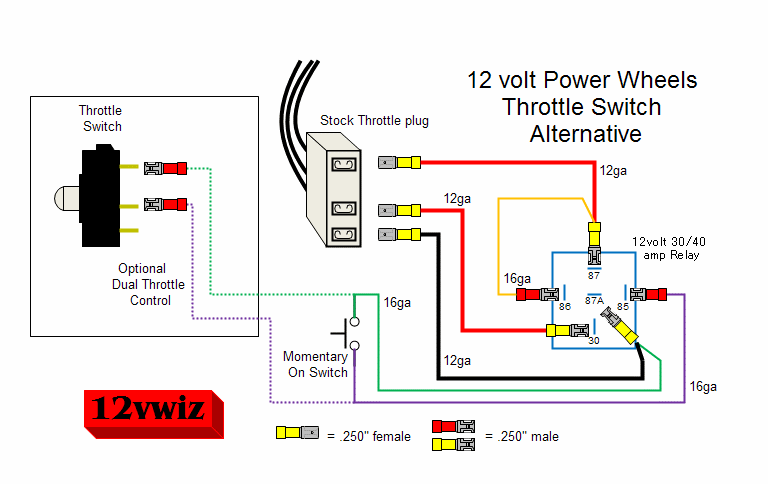
So, you're looking to understand the wiring of your Power Wheels 12V ride-on car? Excellent! Whether you're troubleshooting a mysterious electrical fault, planning a performance upgrade, or just curious about how these little machines work, understanding the wiring diagram is essential. We're going to break down the standard 12V Power Wheels wiring diagram in detail, covering everything from key components to common issues. And the best part? We've got the actual diagram ready for you to download.
Purpose: Why Understand the Wiring Diagram?
Let's be honest: Power Wheels aren't exactly known for their bulletproof reliability. Eventually, something will break. Understanding the wiring diagram empowers you to:
- Troubleshoot Problems: Instead of blindly replacing parts, you can pinpoint the exact source of an issue, saving time and money.
- Perform Repairs: Replacing a faulty switch, motor, or wiring harness becomes much easier when you know how it's connected.
- Upgrade Components: Planning to install a higher-capacity battery, a more powerful motor, or add lights and sound? The wiring diagram is your roadmap.
- Gain Knowledge: Understanding the electrical system provides invaluable insight into how the vehicle operates and allows you to learn the basic principles of electrical engineering.
Key Specs and Main Parts
Before we dive into the diagram, let's cover the core components of a typical 12V Power Wheels:
- Battery (12V): This is the heart of the system, providing the electrical energy to power the motors and other components. 12V batteries are typically lead-acid or lithium-ion.
- Charger: Used to recharge the battery. It's crucial to use the correct charger for your specific battery type to avoid damage or fire hazards.
- Foot Pedal Switch: This is the primary on/off switch, activating the motors when pressed. It's a simple, yet crucial, component.
- Directional Switch (Forward/Reverse): This switch controls the polarity of the voltage applied to the motors, determining the direction of travel. It's often a dual-pole, double-throw (DPDT) switch.
- Motors (12V DC): Typically, there are two motors, one for each rear wheel. These convert electrical energy into mechanical energy, propelling the vehicle. The power rating can vary from 550 to 775 or even higher with modifications.
- Wiring Harness: The network of wires connecting all the components together. The gauge (thickness) of the wires is important; thinner wires can overheat and cause problems if they're carrying too much current.
- Fuse: A safety device designed to protect the circuit from overcurrent. It's a sacrificial component that breaks the circuit if the current exceeds a certain limit.
- Thermal Cutout: Another safety device that protects the motors from overheating. It automatically shuts off the power to the motors if they get too hot.
- High/Low Speed Switch (Optional): Some models include a switch to select between high and low speed.
Symbols: Decoding the Wiring Diagram
Understanding the symbols used in the wiring diagram is crucial for interpreting the information. Here's a breakdown of common symbols:
- Solid Lines: Represent wires. The thickness of the line doesn't necessarily indicate the wire gauge, unless specified in the legend.
- Dotted Lines: Often represent chassis ground connections or less critical connections.
- Battery Symbol: Typically, a series of short and long parallel lines, with the long line indicating the positive (+) terminal and the short line indicating the negative (-) terminal.
- Motor Symbol: A circle with an "M" inside, or a more detailed representation of a DC motor.
- Switch Symbol: A line bridging two or more terminals. The position of the line indicates the switch's current state (open or closed).
- Fuse Symbol: A squiggly line or a rectangular box with a line through it.
- Resistor Symbol: A zig-zag line. (Less common in basic Power Wheels wiring).
- Diode Symbol: A triangle pointing towards a line. (Used for specific applications like preventing reverse current flow).
Color Coding: Wire colors are critical. Standard colors include:
- Red: Positive (+) voltage.
- Black: Negative (-) voltage or ground.
- Other Colors (e.g., Blue, Yellow, Green): Used for specific functions, such as connecting to the motors, switches, or other components. The diagram's legend will specify what each color represents.
How It Works: The Flow of Electricity
The basic operation of a 12V Power Wheels is relatively straightforward. When the foot pedal switch is pressed, it closes the circuit, allowing current to flow from the battery, through the fuse, to the directional switch. The directional switch determines the polarity of the voltage applied to the motors. If the switch is in the forward position, positive voltage is applied to one terminal of each motor, and negative voltage (ground) is applied to the other terminal, causing the motors to rotate in a forward direction. If the switch is in the reverse position, the polarity is reversed, causing the motors to rotate in the opposite direction.
The motors then convert this electrical energy into rotational mechanical energy, which is transmitted to the wheels via a gearbox. The gearbox reduces the speed of the motors while increasing the torque, providing the necessary force to propel the vehicle.
The fuse protects the circuit from overcurrent. If a short circuit occurs or the motors draw excessive current, the fuse will blow, interrupting the flow of electricity and preventing damage to the battery, wiring, or other components.
Real-World Use: Basic Troubleshooting Tips
Here are some common problems and how the wiring diagram can help you diagnose them:
- Vehicle Doesn't Turn On:
- Check the battery voltage: Is it fully charged and holding a charge? Use a multimeter.
- Inspect the fuse: Is it blown? Replace it with the correct amperage fuse.
- Test the foot pedal switch: Use a multimeter to check for continuity when the pedal is pressed.
- Check the wiring connections: Look for loose or corroded connections. Clean and tighten as necessary.
- Vehicle Only Works in One Direction:
- Inspect the directional switch: It might be faulty. Use a multimeter to check for continuity in both the forward and reverse positions.
- Check the wiring to the motors: A wire might be disconnected or damaged.
- Vehicle Runs Briefly and Then Stops:
- Suspect the thermal cutout: It might be tripping due to overheating. Allow the motors to cool down and try again.
- Check for obstructions: The wheels might be binding, causing the motors to work harder and overheat.
Safety: Handling Electrical Components
Working with electrical systems can be dangerous. Always take the following precautions:
- Disconnect the battery: Before working on any wiring, disconnect the battery to prevent accidental shocks or short circuits. This is non-negotiable.
- Wear safety glasses: Protect your eyes from sparks or debris.
- Use insulated tools: Avoid using metal tools that could create a short circuit.
- Work in a well-ventilated area: Battery charging can produce flammable gases.
- Never bypass safety devices: The fuse and thermal cutout are there for a reason. Don't disable them.
- Be careful of the Battery: The 12v battery can deliver a lot of power. Avoid shorting the terminals, as this can cause burns and potentially even an explosion.
The battery and charger are the most risky components. Ensure the correct charger is used, and never leave the battery charging unattended. Overcharging can lead to fire and battery damage.
By understanding the wiring diagram and following these safety precautions, you can confidently troubleshoot and repair your Power Wheels ride-on car. Now that you've got a handle on the theory, let's get practical. We have a detailed wiring diagram available for you to download. It's a valuable resource that you'll find incredibly helpful as you work on your Power Wheels project. Contact us for the file!